
Business
ILEA states where to arrive and IDT how to get there,[1] in the order of its operational layer: Lean first, then automation, then agents.[2] The route joins the two in five steps.
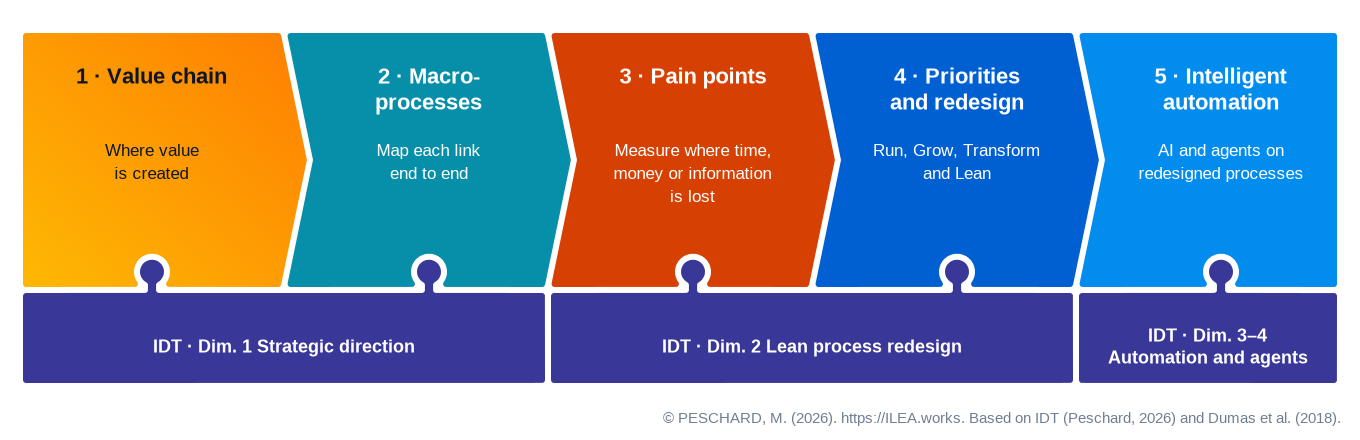
ILEA diagram based on IDT (Peschard, 2026) and Dumas et al. (2018).[2][3]
1 · Value chain: where value is created
The route starts from the primary activities that create and deliver value to the customer, and from the support activities that sustain them, with IT as the meta-support of them all.[4][5]
“The automations that move the needle are the ones that touch that chain.” (Translated from Spanish.)
— Mauricio Peschard, El Ejecutivo de 2040, ch. 2[5]
In detail: Value chain
2 · Macroprocesses: each link, end to end
Each link opens into its end-to-end processes. That is how the process architecture is built: the core, support, and management processes, and how they relate.[3] In retail, for example: purchasing and replenishment, supply chain, stores, and sales (the author’s practice). The process architecture is not invented; it comes from the value chain, and the core processes are its links seen from the inside.[3]
In detail: Processes (BPA and BPM)
3 · Pain points: measure where it is lost
Measure where time, money, or information is lost: cycle time, handoffs between areas, rework, and cost per transaction.[6] Where there is data, process mining reconstructs the real process from the systems' records.[7]
“Do not ask an AI agent to decide the future of a business that cannot yet explain its present.” (Translated from Spanish.)
— Mauricio Peschard, El Ejecutivo de 2040, ch. 2[5]
In detail: KPIs and scorecard · Processes (BPA and BPM)
4 · Priorities and redesign: Run, Grow, Transform and Lean
Each initiative is classified by the value it delivers,[8] and the chosen process is redesigned with a Lean approach, eliminating waste and simplifying steps. This is IDT’s dimension 2, Lean Process Redesign.[9]
“Automating an inefficient process does not improve it; it makes it permanent.” (Translated from Spanish.)
— Mauricio Peschard, El Ejecutivo de 2040, ch. 2[5]
In detail: Run, Grow, Transform · Processes (BPA and BPM)
5 · Intelligent automation: AI and agents on redesigned processes
AI and agents take the tasks; the purpose of each job stays with people, and the judgment to decide is theirs.[10][11] AI is reliable when it works on certified data, and the outcome is measured in business terms.[12]
“An AI answer you cannot compare against anything is not a data point: it is an opinion formatted as a report.” (Translated from Spanish.)
— Mauricio Peschard, El Ejecutivo de 2040, ch. 2[5]
In detail: Purpose and tasks · AI in Business
The route climbs the maturity ladder
Mapping and measuring a process take it to Managed; connecting it with its systems and data, to Integrated; redesigning and automating it, to Optimized (the author’s adaptation).[13] The route is traveled process by process: a quick win takes a single process through the five steps without waiting for the rest of the enterprise. At the enterprise level, however, the weakest link sets the pace.
“An enterprise’s digital maturity is defined not by its best capability but by its weakest.” (Translated from Spanish.)
— Mauricio Peschard, El Ejecutivo de 2040, ch. 2[5]
In detail: Business ladder
References
- Peschard, M. (2026). IDT, v1.3, §16.2: “IDT executes the transformation; ILEA allows that transformation to scale.”
- Peschard, M. (2026). Intelligent Digital Transformation (IDT), v1.3, §8–§11 (layers and dimensions). INDAUTOR Reg. 03-2026-031309345300-01.
- Dumas, M., La Rosa, M., Mendling, J., & Reijers, H. A. (2018). Fundamentals of Business Process Management (2nd ed.). Springer.
- Porter, M. E. (1985). Competitive Advantage: Creating and Sustaining Superior Performance. Free Press.
- Peschard, M. (2026). Chapter 2, “Transformación Digital Inteligente,” in GOCHY® Consulting Consortium, GALACRÁCKTICO® El Ejecutivo de 2040: Pensar Futuro. Decidir Hoy.
- Peschard, M. (2026). IDT, v1.3, §13 (Lean Process Redesign: indicators).
- van der Aalst, W. M. P. (2016). Process Mining: Data Science in Action (2nd ed.). Springer. https://link.springer.com/978-3-662-49850-7
- Potter, K., Solanki, S., & McGee, K. (2016). Run, Grow and Transform the Business IT Spending: Approaches to Categorization and Interpretation (G00308477). Gartner.
- Peschard, M. (2026). IDT, v1.3, §13–§15 (Lean Process Redesign, Intelligent Automation, and Governed Digital Agents).
- Autor, D. H., Levy, F., & Murnane, R. J. (2003). The Skill Content of Recent Technological Change: An Empirical Exploration. The Quarterly Journal of Economics, 118(4), 1279–1333.
- Peschard, M. (2026). IDT, v1.3, §15.4 (Human + AI Operating Model).
- Peschard, M. (2026). IDT, v1.3, §12 (Strategic Direction of the Operating Model; Target Operating Model, MOO-IDT).
- CMMI Institute. CMMI Levels of Capability and Performance. https://cmmiinstitute.com/learning/appraisals/levels