
Business
Domain 1 of the Intelligent & Lean Enterprise Architecture (ILEA™) model.
Purpose of the Domain
To define and govern the organization’s strategy, objectives, operating model, capabilities, processes, and outcomes, ensuring that the entire architecture is oriented to value, to the customer experience, and to achieving organizational objectives.[1][2]
The Business domain describes the desired state (to-be). Intelligent Digital Transformation (IDT) describes how to get there: it defines the target operating model and transforms it through Lean process redesign, intelligent automation, and governed digital agents.[2][3][4]
The Route: From the Value Chain to Intelligent Automation
The Business domain is traveled top-down, in five steps; each one rests on the one before, and each topic on this page appears at the step where it is used (the author’s criterion).[5]
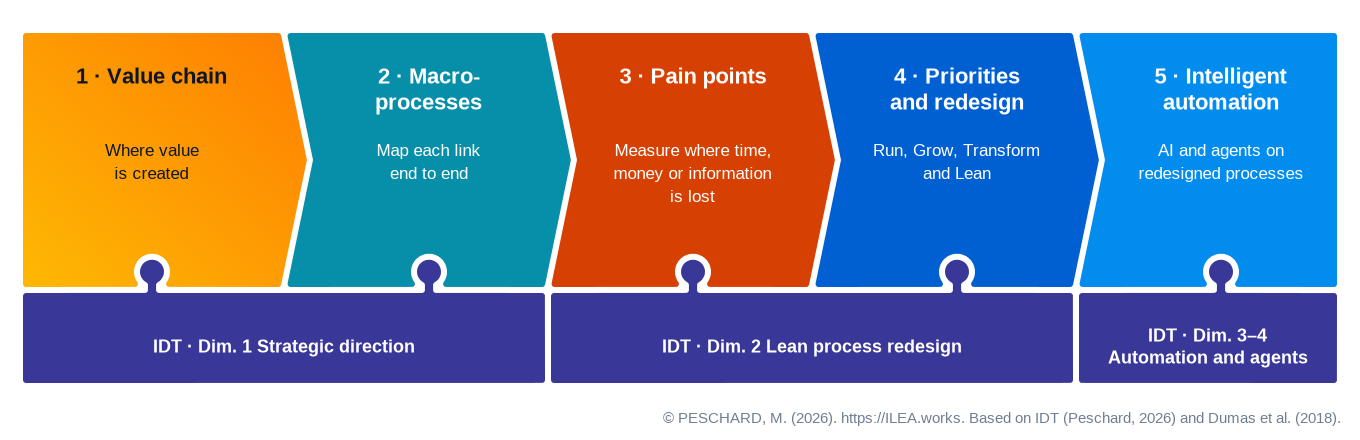
ILEA diagram based on IDT (Peschard, 2026) and Dumas et al. (2018).[6][7]
What Does It Govern / What Does It Design?
Direction and value
- Organizational strategy and objectives[1]
- The value chain as the first focus of the architecture[8]
- Key performance indicators (KPIs) and success criteria[1]
- Investment and evolution priorities, classified as Run, Grow, or Transform, including what will deliberately not be transformed[1][2][9]
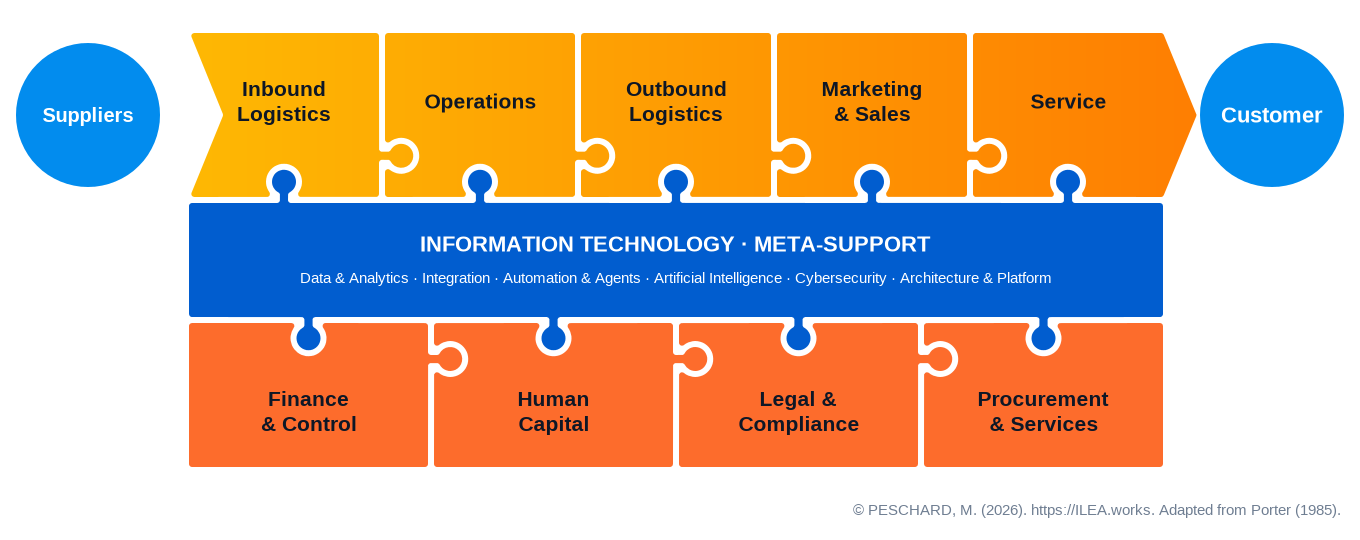
The value chain first
The architecture’s attention starts with the value chain, and Information Technology is the meta-support that enables every one of its activities.[10][8]
KPIs and scorecard
Every KPI measures an objective for the period; directors see two or three per value chain link, and each area breaks them down into tactical and operational KPIs.[11][12]
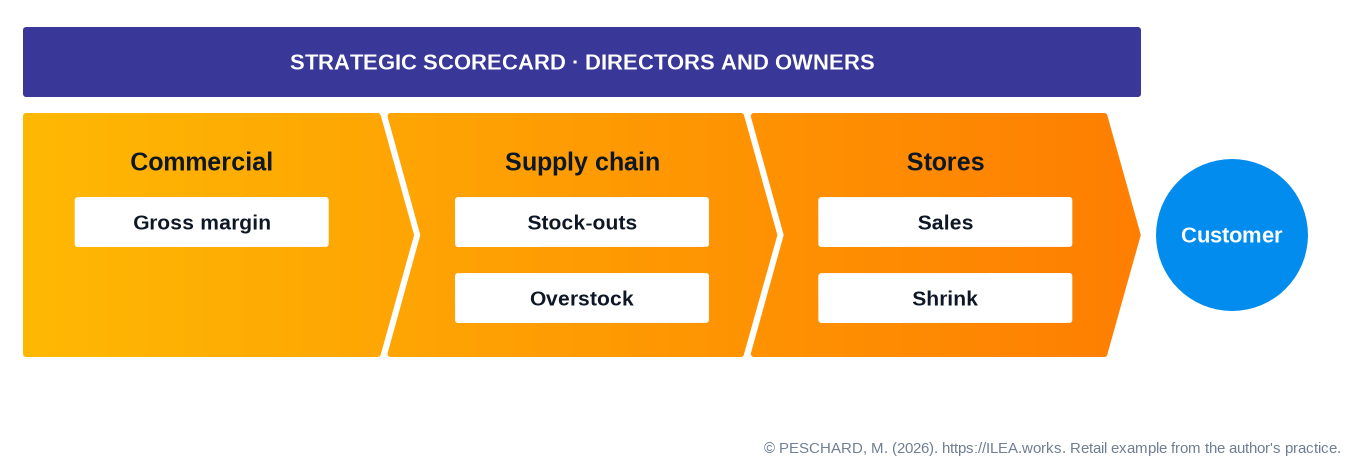
Retail example from the author’s practice.
The cost of short-termism
A scorecard that measures only sales and margin manages for the quarter’s investor. The antidotes: a truly balanced scorecard, with ESG indicators, and leaders formed by experience in the business.[13][14]
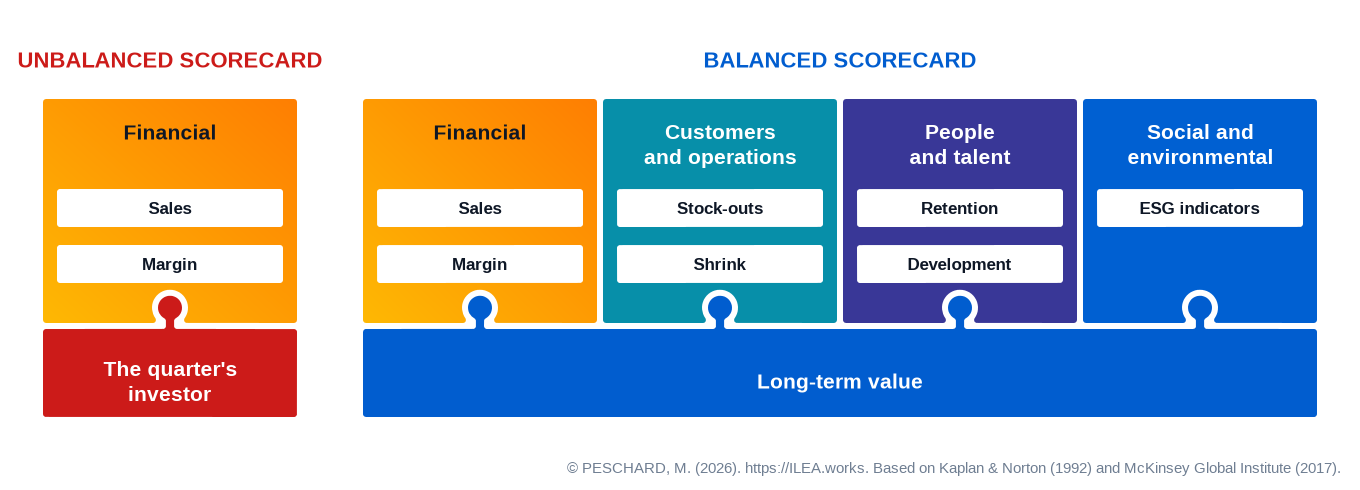
ILEA diagram: the author’s adaptation, based on Kaplan & Norton (1992) and McKinsey Global Institute (2017).[15][13]
Investment priorities: Run, Grow, Transform
Every initiative in the organization, not only in IT, is classified as Run, Grow, or Transform according to the value it delivers.[9]
Operating model and organization
- Target operating model: priority value streams, level of automation, human–AI interaction, critical capabilities, and operating metrics[2]
- Business capabilities[1][16]
- Value streams, customer journeys, and expected outcomes[1][16][17]
- Work design: separating the purpose of each job, which remains human, from its tasks, which AI agents increasingly execute[18][19]
- Organization design for human + AI work[18][20]
Work design: purpose and tasks
The Business domain separates the purpose of each job, which remains human, from its tasks, which AI agents increasingly execute.[19][18]
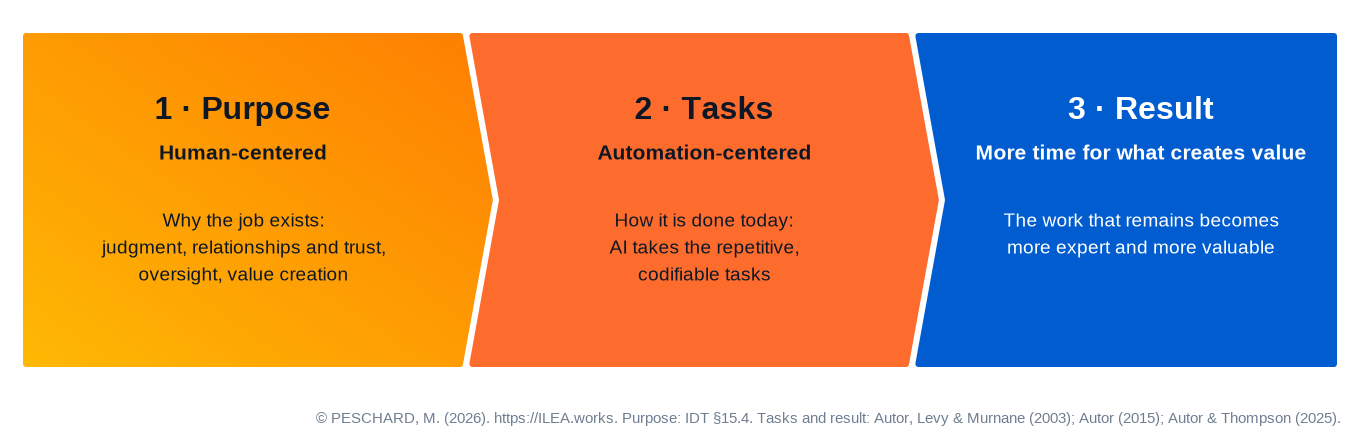
ILEA diagram. Purpose: IDT §15.4.[18] Tasks and result: Autor, Levy & Murnane (2003), Autor (2015), and Autor & Thompson (2025).[19][21][22]
The org chart AI is rewriting
The organizational pyramid is being squeezed from both ends. The Business domain designs an organization with three kinds of members: people in purpose roles, external senior talent engaged fractionally, and AI agents.[20][18]
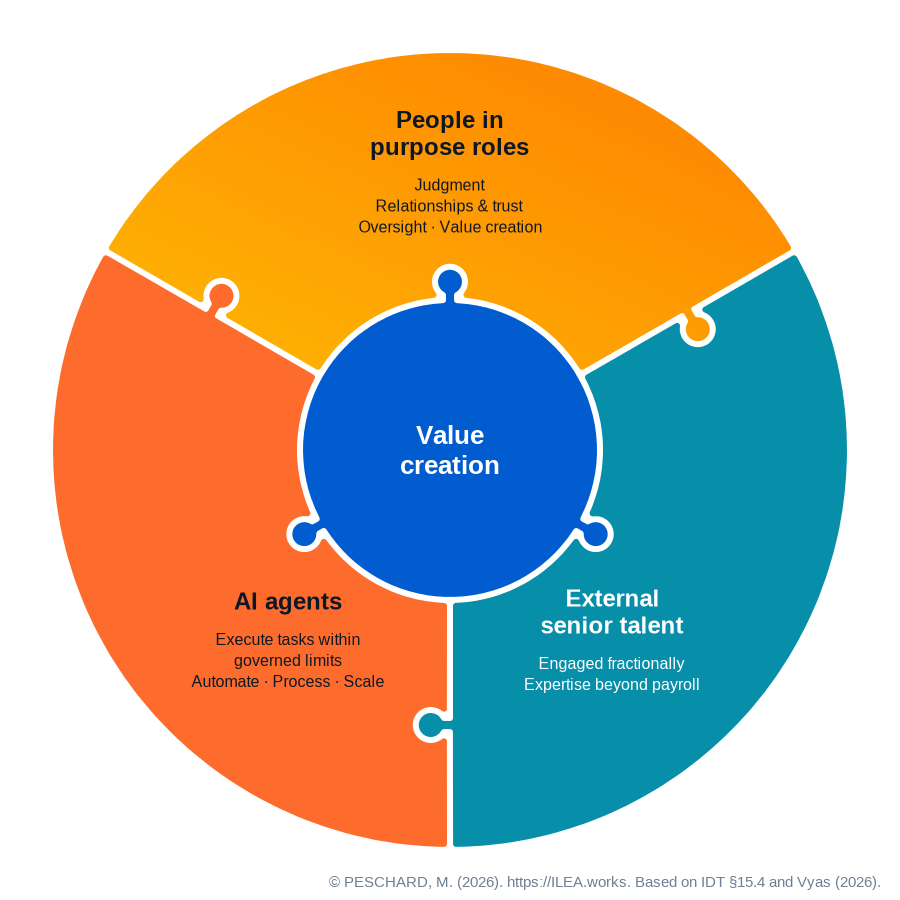
ILEA diagram based on the Human + AI Operating Model[18] and on Vyas (2026).[20]
If you are starting your career
When everyone in the room holds the same prestigious degree, the degree gets you into the room; it no longer sets you apart. How to stand out as a new graduate.[23][20]
Processes and automation
- Process design and redesign under a Lean approach, eliminating waste and simplifying steps[1]
- Intelligent process automation to multiply operational efficiency and accelerate execution[1]
- Agile process analysis and management (BPA and BPM): one value stream at a time, with data and a measurable baseline[7][8]
Agile process analysis and management
One value stream at a time: select it, discover it with data, measure it, redesign it with a Lean approach and automate it, and monitor it in a continuous cycle.[7][24]
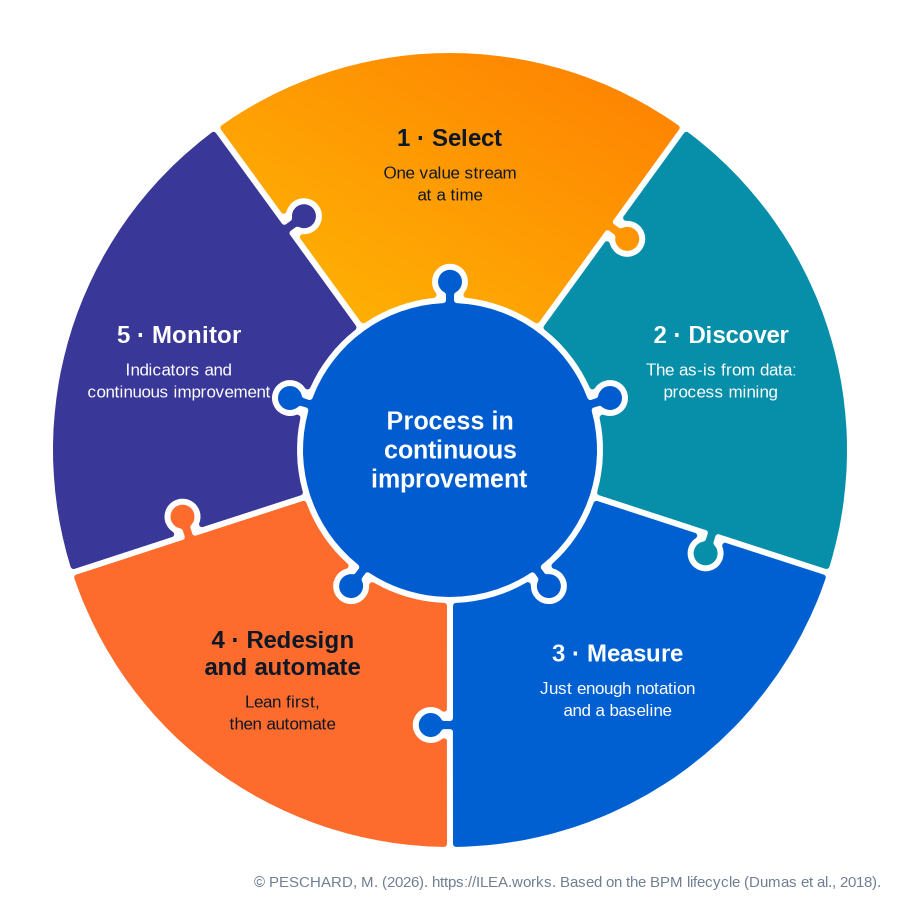
ILEA diagram based on the BPM lifecycle (Dumas et al., 2018).[7]
Business definitions that other domains depend on[25]
- Business rules and decision criteria (used by Agents)[26]
- Business meaning and entities (used by Data)[27]
- Asset criticality and required service and availability levels (used by Security and Platform)[28][29]
- AI use cases, limits, and success criteria (used by the AI metadomain)[30]
Value and Advantages for the Organization
Strategic value
- Clear alignment between strategy and execution[1]
- Prioritization based on value, not technology[1]
- Investment focused where value is created: on the links of the value chain, balanced across Run, Grow, and Transform[8][9]
- Greater focus on measurable outcomes[1]
- Ability to adapt to changes in the environment[1]
- Better-informed and more timely decisions[1]
Operational and organizational value
- Scalability: the business grows in volume without growing headcount at the same pace[3]
- A leaner organization: fewer layers and handoffs, with managers focused on judgment and developing people rather than routing information[20][31]
- Talent focused on what is human: judgment, relationships and trust, oversight, and value creation[21][18]
- Lower resistance to AI adoption, because people understand how AI changes their roles before it happens[32][20]
How value is measured. In business terms, not by the technology implemented: cost per transaction, cycle time of key processes, operating margin, productivity per employee, and level of automation.[2]
Role of Artificial Intelligence in This Domain
Artificial Intelligence enables intelligent process management, making it possible to analyze, redesign, and automate workflows under a Lean approach, eliminating waste and bottlenecks.[1]
AI helps the organization to:
- Identify opportunities for improvement and automation[1]
- Prioritize processes by impact and value[1]
- Orchestrate intelligent automation through agents and workflows[1]
- Sustainably increase operational efficiency[1]
- Move from reactive to predictive and prescriptive decisions[33][8]
Risks of Not Managing It Properly
Strategy and investment
- Technology initiatives (including AI) disconnected from strategy and organizational value[1]
- Scorecard without balance: only sales and margin, for the quarter’s investor[15][13]
- Investment scattered across initiatives that touch no link of the value chain[8]
- Business decisions delegated to IT: value-stream priorities and acceptable agent autonomy decided by whoever installs the technology[8]
Processes and decisions
- Inefficient processes digitized without being optimized[1]
- Isolated automation with no real impact on outcomes[1]
- Low operational efficiency and high operating costs[1]
- Reactive decisions, without analytical or predictive support or continuous learning[1]
- Jumping from raw data straight to agents: asking AI to decide about a business that cannot yet explain its present[8][34]
Organization and people
- Low adoption of digital solutions,[1] often because people learn how AI changes their roles from outside the organization[20]
- Cutting instead of transforming: the budget moves to AI but the work is not redesigned, so the business becomes cheaper, not better.[20][8] In January–August 2026, U.S. employers cited AI in 116,175 announced job cuts, about 22% of the total.[35]
- Hollowing out the first rung: automating entry-level tasks without redesigning how people learn leaves the organization without its future experts and leaders[20]
- Flattening without manager capacity: larger teams without manager talent and support erode engagement[31]
- Automating the relationship: replacing the trust-based relationships that sustain the business destroys value behind better productivity indicators[8]
Dependencies and Relationships with Other Domains
| Domain | Business provides | Business receives |
|---|---|---|
| 2. Agents | Objectives, rules, and decision criteria[26] | Execution and orchestration of automated processes aligned with business objectives[1] |
| 3. Applications | The capabilities and processes that applications must support[36] | Support for the capabilities and processes redesigned under a Lean approach[1] |
| 4. Integration | Value streams and end-to-end processes[37] | Connection of end-to-end processes, both internal and with third parties[1] |
| 5. Data | The meaning and entities of the business[27] | Reliable information and semantics for decision-making[1] |
| 6. Platform | Criticality, priorities, and required service levels[29] | Scalability and speed of execution[1] |
| 7. Security | Asset classification by value, impact, and criticality; required availability and recovery objectives; the frame for prioritizing security, resilience, and compliance controls[28] | Compliance, control, traceability, and trust[1] |
| AI (metadomain) | Objectives, use cases, limits, and success criteria[30] | Intelligent process management and the “intelligence engine” that connects and optimizes the whole architecture[1][30] |
Relationship with Intelligent Digital Transformation (IDT). The Business domain defines the desired state; IDT defines how to get there. Its first dimension, Strategic Direction of the Operating Model, sets the target operating model. Its second and third dimensions, Lean Process Redesign and Intelligent Automation, transform the processes this domain governs. ILEA itself is IDT’s fifth dimension, the structural foundation that lets the transformation scale.[6][4]
Maturity Ladder
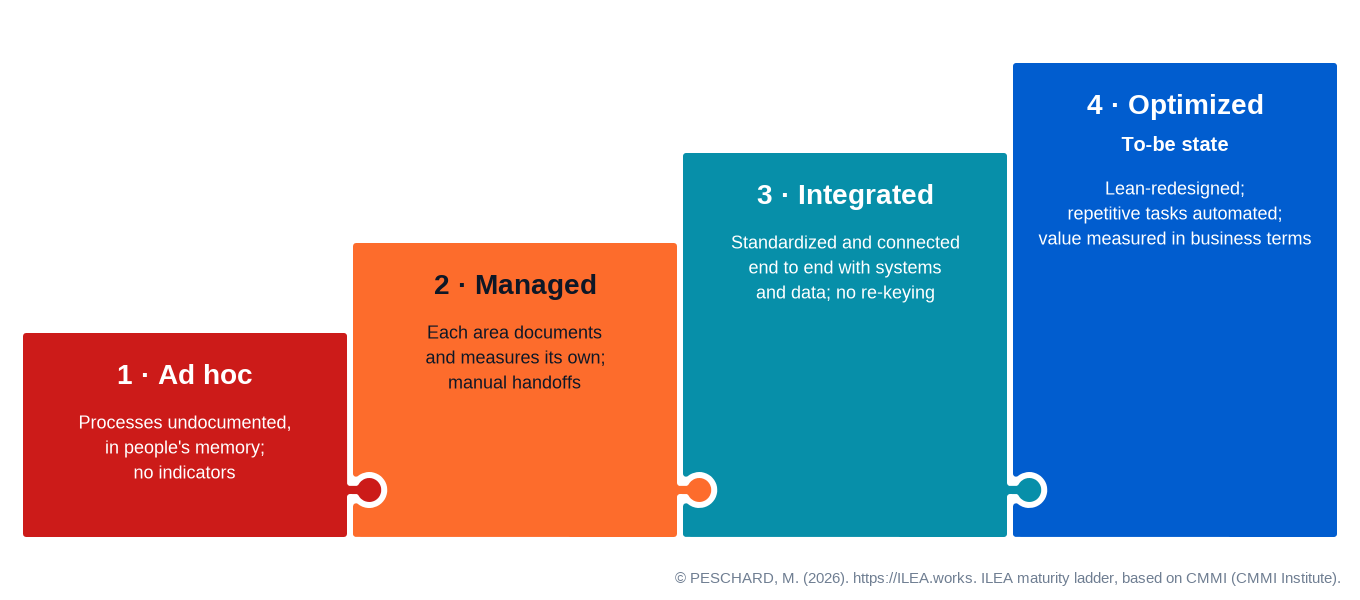
Four levels, from Ad hoc to Optimized, measured on the scope being assessed; level 4 is the desired state this page describes.[38]
Standards
In development; they are published by domain. The standards of this domain will state what the architecture must comply with. How to implement them in each organization is not part of the standard.
References
- Peschard, M. (2026). Intelligent & Lean Enterprise Architecture (ILEA), v1.21, §9.1–§9.2 (Business Domain). INDAUTOR Reg. 03-2026-020309540400-01. https://ilea.works/en/
- Peschard, M. (2026). IDT, v1.3, §12 (Strategic Direction of the Operating Model; Target Operating Model, MOO-IDT).
- Peschard, M. (2026). IDT, v1.3, §13–§15 (Lean Process Redesign, Intelligent Automation, and Governed Digital Agents).
- Peschard, M. (2026). IDT, v1.3, §16.2: “IDT executes the transformation; ILEA allows that transformation to scale.”
- Peschard, M. (2026). Author’s criterion.
- Peschard, M. (2026). Intelligent Digital Transformation (IDT), v1.3, §8–§11 (layers and dimensions). INDAUTOR Reg. 03-2026-031309345300-01.
- Dumas, M., La Rosa, M., Mendling, J., & Reijers, H. A. (2018). Fundamentals of Business Process Management (2nd ed.). Springer.
- Peschard, M. (2026). Chapter 2, “Transformación Digital Inteligente,” in GOCHY® Consulting Consortium, GALACRÁCKTICO® El Ejecutivo de 2040: Pensar Futuro. Decidir Hoy.
- Potter, K., Solanki, S., & McGee, K. (2016). Run, Grow and Transform the Business IT Spending: Approaches to Categorization and Interpretation (G00308477). Gartner.
- Porter, M. E. (1985). Competitive Advantage: Creating and Sustaining Superior Performance. Free Press.
- Doerr, J. (2018). Measure What Matters. Portfolio/Penguin. See also What Matters, OKR meaning, definition and example. https://www.whatmatters.com/faqs/okr-meaning-definition-example
- Eckerson, W. W. (2010). Performance Dashboards: Measuring, Monitoring, and Managing Your Business (2nd ed.). Wiley.
- Barton, D., Manyika, J., Koller, T., Palter, R., Godsall, J., & Zoffer, J. (2017, February). Measuring the Economic Impact of Short-termism (discussion paper). McKinsey Global Institute. https://karriere.mckinsey.de/~/media/mckinsey/featured%20insights/long%20term%20capitalism/where%20companies%20with%20a%20long%20term%20view%20outperform%20their%20peers/measuring-the-economic-impact-of-short-termism.pdf
- Miller, D., & Xu, X. (2019). MBA CEOs, Short-Term Management and Performance. Journal of Business Ethics, 154(2), 285–300. https://doi.org/10.1007/s10551-017-3450-5
- Kaplan, R. S., & Norton, D. P. (1992). The Balanced Scorecard: Measures That Drive Performance. Harvard Business Review, January–February 1992. https://hbr.org/1992/01/the-balanced-scorecard-measures-that-drive-performance-2
- Business Architecture Guild. A Guide to the Business Architecture Body of Knowledge (BIZBOK® Guide). https://www.businessarchitectureguild.org
- Rawson, A., Duncan, E., & Jones, C. (2013). The Truth About Customer Experience. Harvard Business Review, 91(9), 90–98.
- Peschard, M. (2026). IDT, v1.3, §15.4 (Human + AI Operating Model).
- Autor, D. H., Levy, F., & Murnane, R. J. (2003). The Skill Content of Recent Technological Change: An Empirical Exploration. The Quarterly Journal of Economics, 118(4), 1279–1333.
- Vyas, D. (2026, October 9). How AI Is Rewriting The Corporate Org Chart [Video]. 2026 Forbes Future of Work Summit. Forbes. https://www.youtube.com/watch?v=lqzETOkufSg
- Autor, D. H. (2015). Why Are There Still So Many Jobs? The History and Future of Workplace Automation. Journal of Economic Perspectives, 29(3), 3–30.
- Autor, D., & Thompson, N. (2025). Expertise (NBER Working Paper 33941). National Bureau of Economic Research. https://www.nber.org/papers/w33941
- SignalFire. (2026, June 22). State of Talent Report 2026. https://www.signalfire.com/blog/signalfire-state-of-talent-report-2026
- van der Aalst, W. M. P. (2016). Process Mining: Data Science in Action (2nd ed.). Springer. https://link.springer.com/978-3-662-49850-7
- Peschard, M. (2026). ILEA, v1.21, §10.2, §11.2, §12.2, §13.2, §14.2, §15.2, and §16.2 (each domain’s dependency on Business).
- Peschard, M. (2026). ILEA, v1.21, §10.1–§10.2 (Agents Domain).
- Peschard, M. (2026). ILEA, v1.21, §13.2 (Data Domain).
- Peschard, M. (2026). ILEA, v1.21, §14.2 (Security Domain).
- Peschard, M. (2026). ILEA, v1.21, §15.2 (Platform Domain).
- Peschard, M. (2026). ILEA, v1.21, §16.2 (Artificial Intelligence Metadomain).
- Harter, J. (2026, January 13). Span of Control: What’s the Optimal Team Size for Managers? Gallup. https://www.gallup.com/workplace/700718/span-control-optimal-team-size-managers.aspx
- Peschard, M. (2026). IDT, v1.3 (pptx), speaker notes, slide 31.
- Chandler, N., Hostmann, B., Rayner, N., & Herschel, G. (2011). Gartner’s Business Analytics Framework. Gartner. Cited in Siow, E., Tiropanis, T., & Hall, W. (2018). Analytics for the Internet of Things: A Survey. arXiv:1807.00971.
- MIT NANDA. (2025). The GenAI Divide: State of AI in Business 2025. Massachusetts Institute of Technology.
- Challenger, Gray & Christmas. (2026, September 2). Challenger Report: August Job Cuts Up 58%, Consumer Products, Food Lead. https://www.challengergray.com/blog/challenger-report-august-job-cuts-up-58-consumer-products-food-lead/
- Peschard, M. (2026). ILEA, v1.21, §11.2 (Applications Domain).
- Peschard, M. (2026). ILEA, v1.21, §12.2 (Integration Domain).
- CMMI Institute. CMMI Levels of Capability and Performance. https://cmmiinstitute.com/learning/appraisals/levels