
Business
← 1. Business Domain · The org chart AI is rewriting
AI is hitting the first rung first. Employment of workers aged 22 to 25 in AI-exposed occupations is 19% below where it would have been, while experienced workers show no such gap; the decline concentrates where AI substitutes tasks, not where it complements them.[1] New-graduate hiring at the largest technology companies is down about 65% from 2019, and graduates of the top 20 computer science programs are 45% less likely to land there than the class of 2022.[2] When everyone in the room holds the same prestigious degree, the degree gets you into the room; it no longer sets you apart.[2]
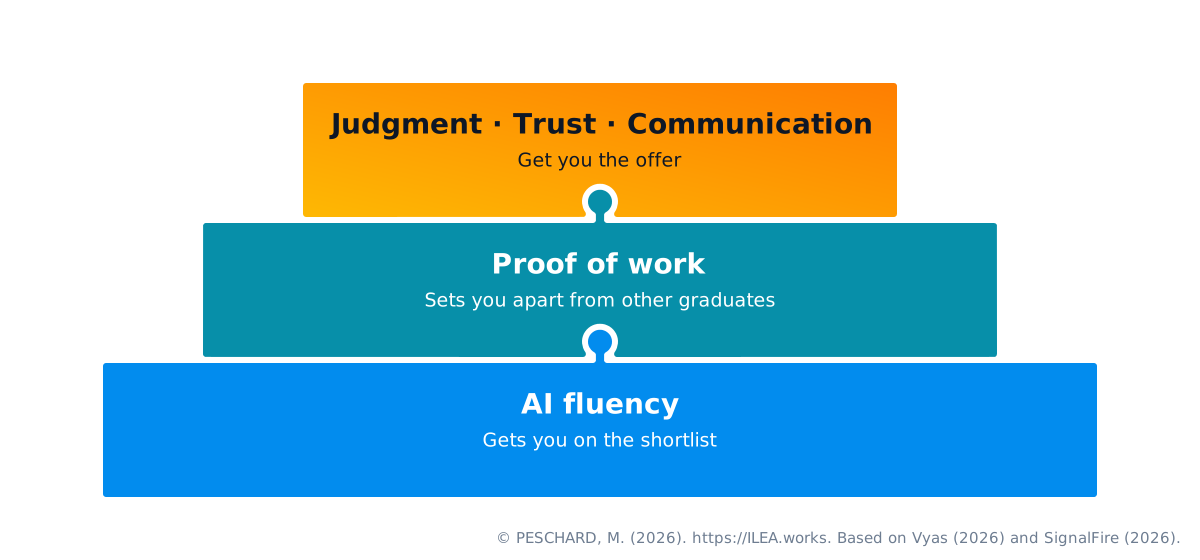
Diagram based on Vyas (2026)[3] and SignalFire (2026).[2]
- AI fluency is the floor. It gets you on the shortlist: 71% of leaders would rather hire a less experienced candidate with AI skills than a more experienced one without them, 66% would not hire someone without them, and 77% expect AI to give early-career talent greater responsibilities.[4][3]
- Bring proof. With fewer junior seats, candidates win on work they can show, including work done with AI: projects delivered, problems solved, results documented.[3][2][5]
- Judgment, trust, and communication get you the offer. They are the territories that remain human.[3][6]
- Learn the purpose of the job, not only its tasks. Tasks are automated; the purpose remains.[7][8]
- Choose where AI complements you, not where it substitutes you. Prefer internships in teams already working with AI over prestige alone.[1][2]
References
- Brynjolfsson, E., Chandar, B., & Chen, R. (2026, August 12). Canaries in the Coal Mine? Six Facts about the Recent Employment Effects of Artificial Intelligence (revised working paper). Stanford Digital Economy Lab. https://digitaleconomy.stanford.edu/publications/canaries-in-the-coal-mine
- SignalFire. (2026, June 22). State of Talent Report 2026. https://www.signalfire.com/blog/signalfire-state-of-talent-report-2026
- Vyas, D. (2026, October 9). How AI Is Rewriting The Corporate Org Chart [Video]. 2026 Forbes Future of Work Summit. Forbes. https://www.youtube.com/watch?v=lqzETOkufSg
- Microsoft & LinkedIn. (2024, May 8). 2024 Work Trend Index: AI at Work Is Here. Now Comes the Hard Part. https://www.microsoft.com/en-us/worklab/work-trend-index/ai-at-work-is-here-now-comes-the-hard-part
- National Association of Colleges and Employers. (2025, November). Job Outlook 2026. https://www.naceweb.org/research/reports/job-outlook/2026/
- Peschard, M. (2026). IDT, v1.3, §15.4 (Human + AI Operating Model).
- Autor, D. H. (2015). Why Are There Still So Many Jobs? The History and Future of Workplace Automation. Journal of Economic Perspectives, 29(3), 3–30.
- Peschard, M. (2026). Chapter 2, “Transformación Digital Inteligente,” in GOCHY® Consulting Consortium, GALACRÁCKTICO® El Ejecutivo de 2040: Pensar Futuro. Decidir Hoy.