
Intelligent & Lean Enterprise Architecture (ILEA™)
Enterprise architecture stops being documentation and becomes a strategic advantage for the organization.
“[The most popular EA frameworks, including Zachman, TOGAF, and FEAF,] are nothing more than typical management fads aggressively promoted by consulting companies and gurus. They are useless at best and harmful at worst.”
— Svyatoslav Kotusev, independent enterprise architecture researcher, educator, and consultant; PhD in Information Systems, RMIT University (Australia). Enterprise Architecture Frameworks: The Fad of the Century, BCS, 2016.
Objectives
- To define and formalize an original, practical, and agile model of Intelligent and Lean Enterprise Architecture, aimed at establishing the desired (to-be) state of modern enterprise architecture in the face of today’s challenges of complexity, speed, and continuous change.
- To establish a clear and coherent structural framework that overcomes the limitations of traditional Enterprise Architecture approaches, incorporating Artificial Intelligence as a cross-cutting meta-domain and recognizing the central role of agents, data, and digital platforms.
- To provide a common, practical, and agile reference for aligning strategy, capabilities, processes, and technology, allowing flexible adoption across different organizational contexts.
- To steer the evolution of Enterprise Architecture toward a more adaptable, lean, and value-oriented approach, reducing unnecessary complexity and enabling new forms of organizational design, governance, and operation.
What ILEA Is
ILEA is an original, practical, and agile model of Enterprise Architecture that defines the structural framework, with the principles and domains that make up the desired (to-be) state of an intelligent and lean enterprise architecture. It was created by Mauricio Peschard, an enterprise architect with more than 30 years of experience, 20 of them at The Home Depot Mexico and the United States.
The model consists of:
- Principles of the Intelligent & Lean Enterprise Architecture model
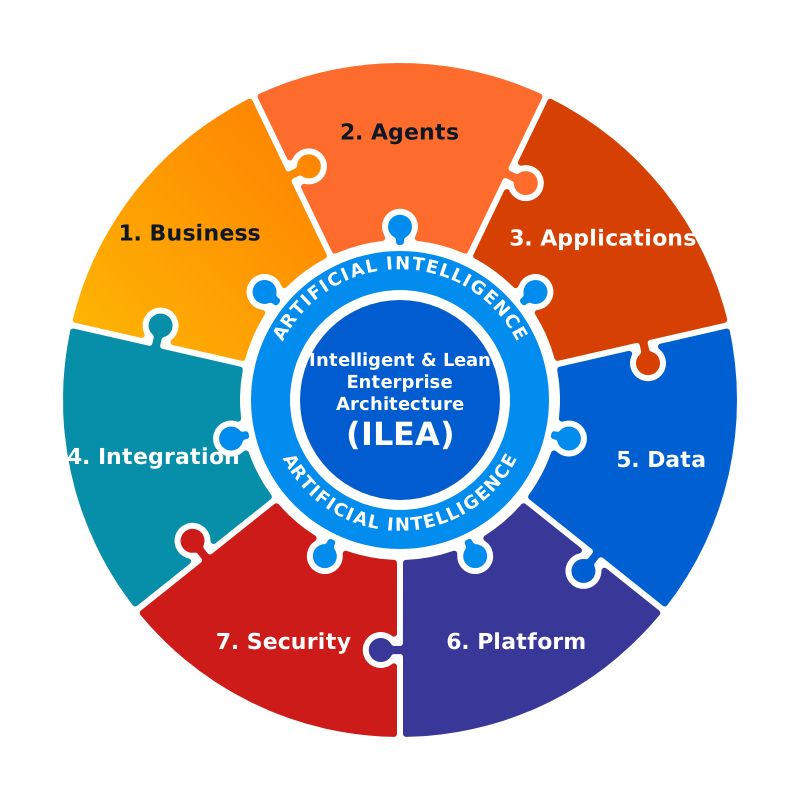
- A distinctive graphic representation that visually expresses the relationship between the seven clearly defined domains and an Artificial Intelligence meta-domain.
- A formal description of each domain that sets out its purpose; what it governs and what it designs; its value and advantages for the organization; the role of Artificial Intelligence; the risks of not managing it properly; and its dependencies and relationships with other domains.
It is designed as a structural reference for the design, assessment, and evolution of enterprise architectures in environments driven by Artificial Intelligence, agents, and managed digital platforms.
What It’s For
- To establish a practical, clear, and coherent reference for understanding, analyzing, and defining enterprise architectures in modern organizational contexts.
- To provide a common framework of understanding that enables executives, architects, and technology leaders to align vision, decisions, and architectural design under a single language.
- To serve as a basis for assessing and evolving existing enterprise architectures, making it easier to identify gaps between the current state and the desired state.
- To support strategic decision-making related to digital transformation, organizational modernization, and the adoption of new capabilities.