
Business
The organizational pyramid is being squeezed from both ends. AI is thinning the layers of managers and entry-level roles, experienced individual contributors carry more weight, and new roles appear, such as Chief AI Officers and AI forward-deployed engineers.[1] In the United States, the average number of people reporting to each manager rose from 10.9 in 2024 to 12.1 in 2025. The median, however, held steady at about five to six, and Gallup concludes that manager talent matters more than span of control.[2]
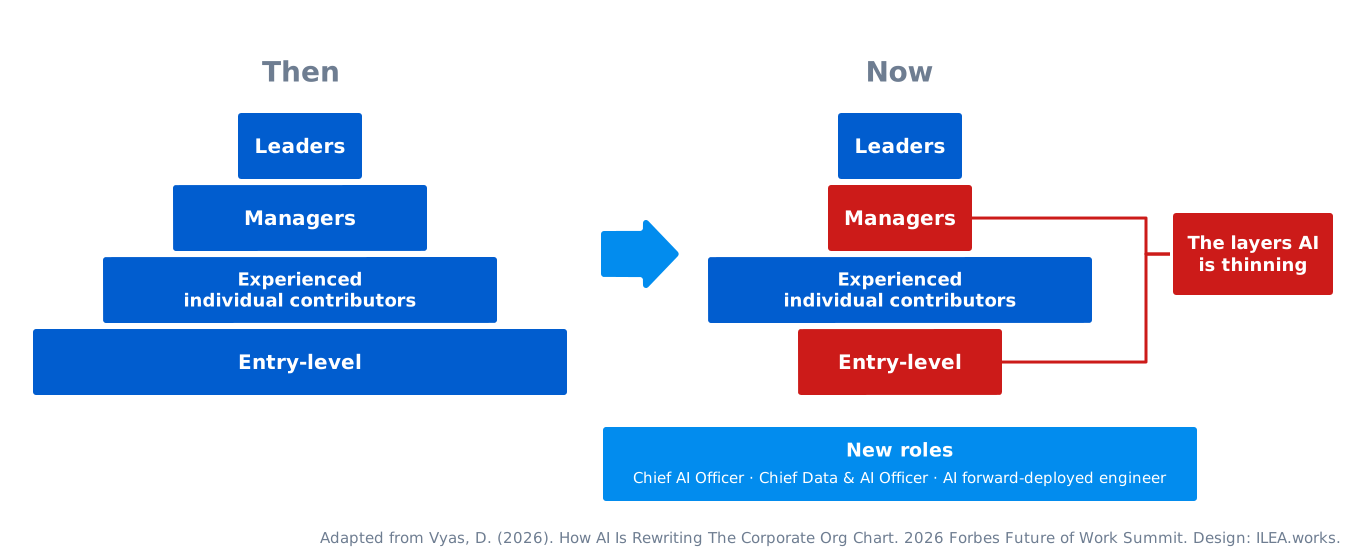
Diagram adapted from Vyas (2026), 2026 Forbes Future of Work Summit.[1]
The Business domain designs this org chart deliberately, not as the residue of cuts:
- Three kinds of members. People in human purpose roles, external senior talent engaged fractionally, and AI agents that execute tasks within governed limits: the org chart extends past payroll.[3][1]
- Managers who coach, not route. Passing information up and down was a task, and data and agents absorb it. The manager’s purpose, judgment and developing people, remains human.[4][1][2]
- A first rung rebuilt, not removed. Entry roles become apprenticeships alongside AI; without juniors today, there are no leaders tomorrow.[1]
- A new bar for talent. Roles are written around outcomes that will evolve. AI fluency is the floor; judgment, trust, and communication make the difference, which are the same territories that remain human.[1][3]
- People hear it first. The organization explains how AI changes each role before it is announced outside.[1]
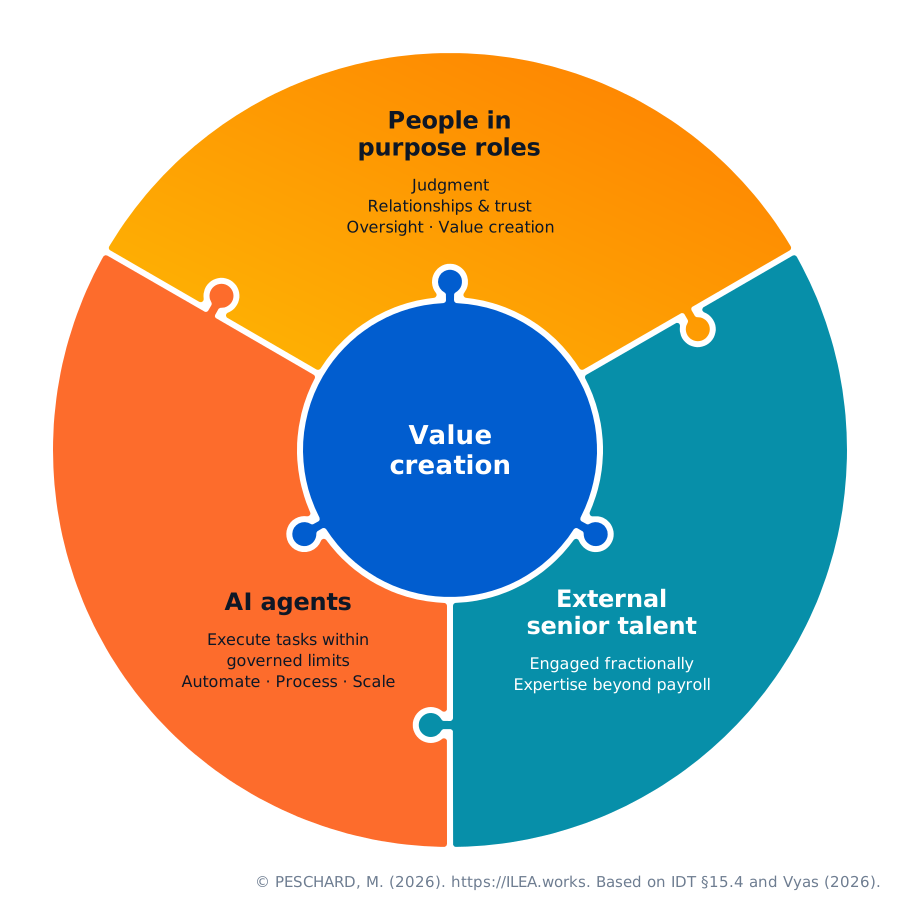
ILEA diagram based on the Human + AI Operating Model[3] and on Vyas (2026).[1]
Next: If you are starting your career
References
- Vyas, D. (2026, October 9). How AI Is Rewriting The Corporate Org Chart [Video]. 2026 Forbes Future of Work Summit. Forbes. https://www.youtube.com/watch?v=lqzETOkufSg
- Harter, J. (2026, January 13). Span of Control: What’s the Optimal Team Size for Managers? Gallup. https://www.gallup.com/workplace/700718/span-control-optimal-team-size-managers.aspx
- Peschard, M. (2026). IDT, v1.3, §15.4 (Human + AI Operating Model).
- Autor, D. H. (2015). Why Are There Still So Many Jobs? The History and Future of Workplace Automation. Journal of Economic Perspectives, 29(3), 3–30.