
Business
The Business domain designs how work is organized. A job is a bundle of tasks, and technology takes over tasks, not whole jobs: it substitutes routine, codifiable tasks and complements nonroutine ones, such as problem-solving, complex communication, adaptability, and creativity.[1][2] ILEA adds a second layer: every job also has a purpose, and the purpose remains human: judgment, relationships and trust, oversight, and value creation. The tasks are increasingly executed by AI agents within governed limits, and the result is a lean organization that combines human purpose roles with AI agents.[3]
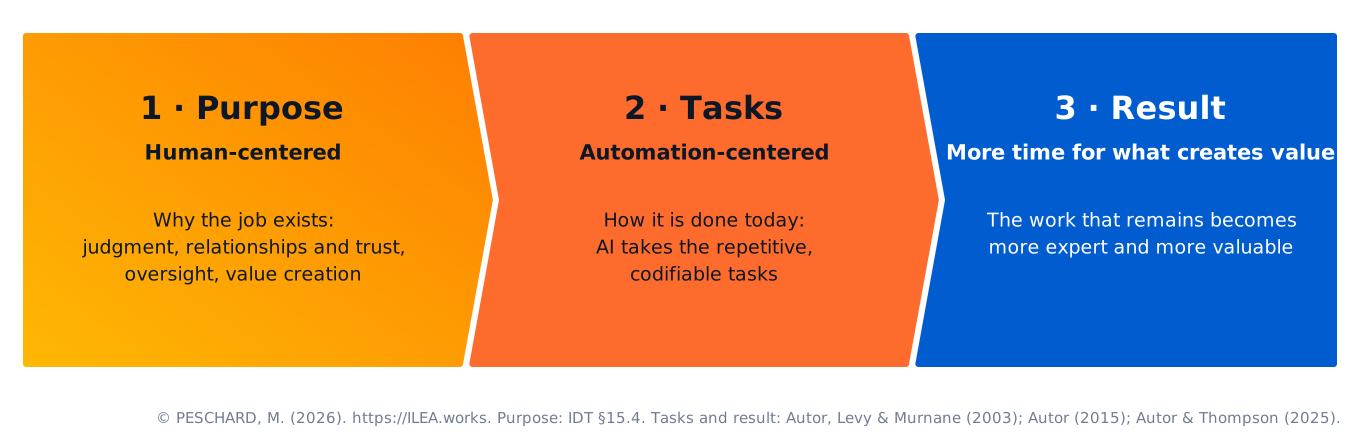
ILEA diagram. Purpose: IDT §15.4.[3] Tasks and result: Autor, Levy & Murnane (2003), Autor (2015), and Autor & Thompson (2025).[1][2][4]
When automation takes over the simpler tasks, the work that remains becomes more expert and better paid. Between 1980 and 2018, computers took over many of the tasks of bookkeepers and accounting clerks: their employment fell by a third, while their real hourly wages rose by nearly 40%.[4][5] Autor also argues that AI, unlike earlier computing, can help more workers take on decisions that used to be reserved for experts.[6]
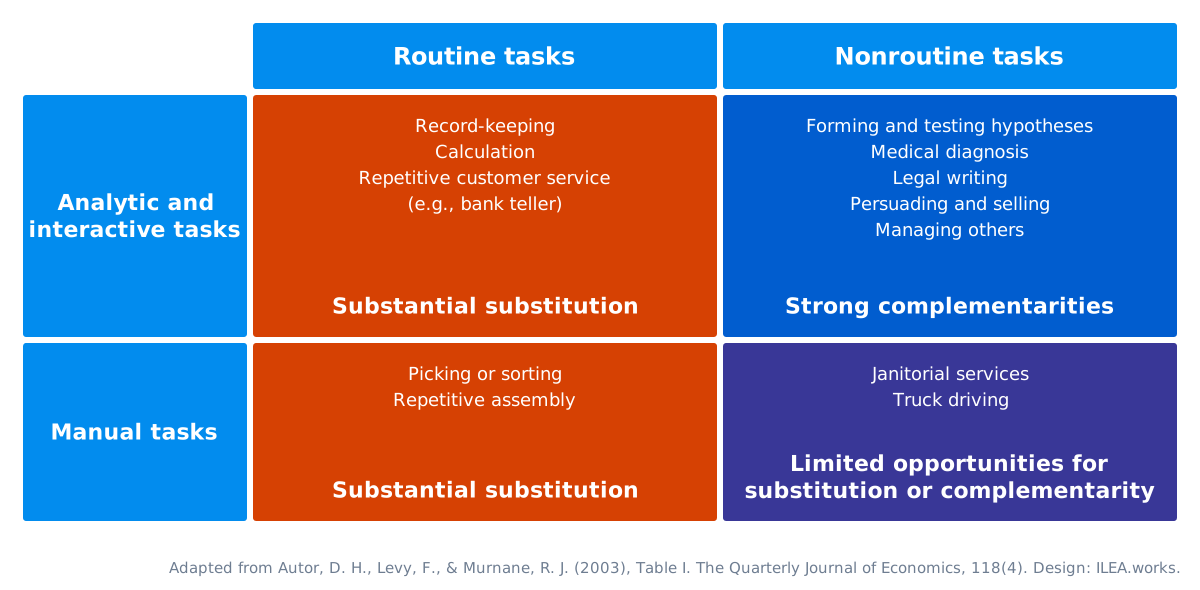
Adapted from Autor, Levy & Murnane (2003), Table I.[1] The matrix predates generative AI, which is beginning to support nonroutine work as well.[6]
References
- Autor, D. H., Levy, F., & Murnane, R. J. (2003). The Skill Content of Recent Technological Change: An Empirical Exploration. The Quarterly Journal of Economics, 118(4), 1279–1333.
- Autor, D. H. (2015). Why Are There Still So Many Jobs? The History and Future of Workplace Automation. Journal of Economic Perspectives, 29(3), 3–30.
- Peschard, M. (2026). IDT, v1.3, §15.4 (Human + AI Operating Model).
- Autor, D., & Thompson, N. (2025). Expertise (NBER Working Paper 33941). National Bureau of Economic Research. https://www.nber.org/papers/w33941
- Murray, S. (2025, August 18). A new look at how automation changes the value of labor. MIT Sloan, Ideas Made to Matter. https://mitsloan.mit.edu/ideas-made-to-matter/a-new-look-how-automation-changes-value-labor
- Autor, D. (2024). Applying AI to Rebuild Middle Class Jobs (NBER Working Paper 32140). National Bureau of Economic Research. https://www.nber.org/papers/w32140