
Business
A scorecard can be called balanced without being so. If it measures only sales and margin, it manages for the quarter’s investor, and financial measures alone send misleading signals for improvement and innovation.[1]
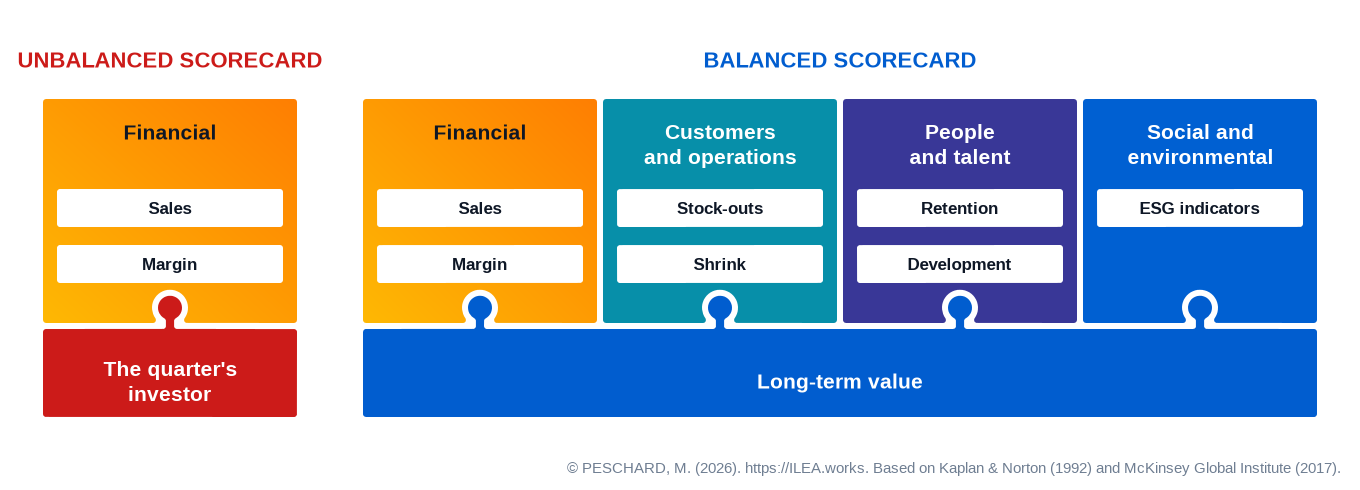
ILEA diagram: the four groups are the author’s adaptation, based on Kaplan & Norton (1992) and McKinsey Global Institute (2017).[1][2]
The evidence
- Short-termism costs growth. McKinsey Global Institute studied 615 U.S. companies from 2001 to 2014. In long-term companies, revenue grew 47% more and earnings 36% more; they invested almost 50% more in R&D, kept investing during the crisis, and each added about 12,000 more jobs.[2]
- Even its champion said so. In 2009, Jack Welch, the CEO most associated with shareholder value, said that shareholder value “is a result, not a strategy.”[3]
- Management changed course. In 2019, 181 CEOs of the Business Roundtable moved beyond shareholder primacy and committed to customers, employees, suppliers, communities, and shareholders.[4]
Three documented cases
They do not prove causation; they are public, documented lessons.
- Intel. It declined to make the chip for the first iPhone because Apple’s price was below its forecast cost; its CEO later acknowledged that the volume turned out 100 times larger than anyone expected.[5] In 2017–2018 it also passed on a 15% stake in OpenAI, over doubts about the return.[6]
- Boeing. On the 787 it outsourced about 65% of the airframe and ran nearly three years late, with billions of dollars in cost overruns.[7] The U.S. Congress concluded that on the 737 MAX the company gave in to “production pressure.”[8]
- GE. According to Gelles, the pursuit of the share price through layoffs, outsourcing, offshoring, and buybacks weakened GE and became a model for other companies.[9] Gryta and Mann document its later fall.[10]
First antidote: a truly balanced scorecard
Alongside the financial indicators go those of customers and operations, of people and talent, and the social and environmental ones (the author’s adaptation).[1] The latter are known as CSR (corporate social responsibility) and are measured with ESG indicators (environmental, social, and governance). In Mexico, Cemefi’s ESR Distinction (Socially Responsible Company) assesses ESG indicators with evidence.[11]
“Sustainability creates value when it enters strategy, operations, and decision-making. The goal should not be only to win a medal, produce a report, or answer a questionnaire, but to turn ESG commitments into efficiency, risk reduction, market access, and competitive advantage.” (Translated from Spanish.)
— Carmelo Santillán Ramos, PhD, CSR Consulting[12]
Each indicator follows the rules of KPIs and scorecard: it measures an objective, has an owner, and has one single definition.
Second antidote: experience in the business weighs more than the title
- Expert leaders perform better. In about 15,000 NBA games (1996–2004), teams coached by former star players won more: a coach who was an All-Star is worth about six places in the league table. The authors conclude that organizations perform better when led by someone with deep knowledge of their core activity.[13]
- An MBA without experience leans toward the short term. In major U.S. public companies, CEOs with an MBA turn more often to short-term tactics, such as earnings management and cutting R&D, and the company’s market value then falls.[14]
- An outside CEO is a riskier bet. On average, the performance difference between inside and outside CEOs is unclear, but outsiders produce more extreme outcomes, either very good or very bad.[15]
- Wisdom comes from experience. Jack Ma held that school gives knowledge, but running a business requires wisdom, and only experience gives it.[16]
- Intel illustrates it. Its two most costly decisions, in mobile and in AI, were made by leaders trained in finance, not in engineering. Paul Otellini, its first CEO who was not an engineer,[17] declined the iPhone chip because the price was below the forecast cost.[5] Bob Swan, who had been its chief financial officer before becoming CEO,[18] passed on OpenAI over doubts about the return.[6] In both cases the financial forecast weighed more than knowledge of the core business (the author’s reading); this does not prove causation, but it matches what the evidence above describes.
The conclusion (the author’s criterion, based on this evidence): develop your leaders from experience in the business and its technology; an MBA complements that experience, it does not replace it.[19]
References
- Kaplan, R. S., & Norton, D. P. (1992). The Balanced Scorecard: Measures That Drive Performance. Harvard Business Review, January–February 1992. https://hbr.org/1992/01/the-balanced-scorecard-measures-that-drive-performance-2
- Barton, D., Manyika, J., Koller, T., Palter, R., Godsall, J., & Zoffer, J. (2017, February). Measuring the Economic Impact of Short-termism (discussion paper). McKinsey Global Institute. https://karriere.mckinsey.de/~/media/mckinsey/featured%20insights/long%20term%20capitalism/where%20companies%20with%20a%20long%20term%20view%20outperform%20their%20peers/measuring-the-economic-impact-of-short-termism.pdf
- Jack Welch, interview with the Financial Times, March 2009, as reported by Grist (2009, March 16), https://grist.org/article/2009-03-16-former-ge-chief-jack-welch, and by Bloomberg (2014, December 4), https://brp-prod-bcc.bloomberg.com/news/articles/2014-12-04/shareholder-value-friedman-linked-profits-social-responsibility
- Business Roundtable. (2019, August 19). Business Roundtable Redefines the Purpose of a Corporation to Promote 'An Economy That Serves All Americans'. https://www.businessroundtable.org/business-roundtable-redefines-the-purpose-of-a-corporation-to-promote-an-economy-that-serves-all-americans
- AppleInsider. (2013, May 16). Intel chips could have powered first iPhone, CEO Otellini says (reporting Paul Otellini’s interview with The Atlantic). https://appleinsider.com/articles/13/05/16/intel-chips-could-have-powered-first-iphone-ceo-otelini-says
- Cherney, M. A. (2024, August 7). How chip giant Intel spurned OpenAI and fell behind the times. Reuters. https://www.reuters.com/technology/artificial-intelligence/how-chip-giant-intel-spurned-openai-fell-behind-times-2024-08-07/
- Peterson, K. (2011, March 11). A Wing and a Prayer: Outsourcing at Boeing. Reuters, republished by YaleGlobal. https://archive-yaleglobal.yale.edu/content/wing-and-prayer-outsourcing-boeing
- U.S. House Committee on Transportation and Infrastructure. (2020, September 16). Final Committee Report on the Boeing 737 MAX (majority staff). https://democrats-transportation.house.gov/news/press-releases/after-18-month-investigation-chairs-defazio-and-larsen-release-final-committee-report-on-boeing-737-max
- Gelles, D. (2022). The Man Who Broke Capitalism: How Jack Welch Gutted the Heartland and Crushed the Soul of Corporate America—and How to Undo His Legacy. Simon & Schuster.
- Gryta, T., & Mann, T. (2020). Lights Out: Pride, Delusion, and the Fall of General Electric. Houghton Mifflin Harcourt.
- Cemefi. (2025). Convocatoria Distintivo ESR® 2026, empresas grandes. https://www.cemefi.org/wp-content/uploads/2025/09/2026-ConvocatoriaGrandes.pdf
- Santillán Ramos, C. (2026, October 22). Quoted in CSR Consulting, Dr. Carmelo Santillán Ramos refuerza la proyección de CSR Consulting tras reconocimientos en Oxford y Harvard [press release]. EIN Presswire. https://www.einpresswire.com/article/951391932/dr-carmelo-santill-n-ramos-refuerza-la-proyecci-n-de-csr-consulting-tras-reconocimientos-en-oxford-y-harvard Attribution confirmed by its author (2026, October 29).
- Goodall, A. H., Kahn, L. M., & Oswald, A. J. (2011). Why do leaders matter? A study of expert knowledge in a superstar setting. Journal of Economic Behavior & Organization, 77(3), 265–284. See also University of Warwick (2008, June 12), https://warwick.ac.uk/newsandevents/pressreleases/star_basketball_players
- Miller, D., & Xu, X. (2019). MBA CEOs, Short-Term Management and Performance. Journal of Business Ethics, 154(2), 285–300. https://doi.org/10.1007/s10551-017-3450-5
- Quigley, T. J., Hambrick, D. C., Misangyi, V. F., & Rizzi, G. A. (2019). CEO selection as risk-taking: A new vantage on the debate about the consequences of insiders versus outsiders. Strategic Management Journal, 40, 1453–1470. https://doi.org/10.1002/smj.3033
- Clark, D. (2016). Alibaba: The House That Jack Ma Built. Ecco.
- Berkeley Haas. (2018). Paul Otellini (Berkeley Haas Magazine, Spring 2018). https://newsroom.haas.berkeley.edu/magazine/spring-2018/paul-otellini/
- Intel Corporation. (2019, January 31). Intel Names Robert Swan CEO (Form 8-K, Exhibit 99.1). U.S. Securities and Exchange Commission. https://www.sec.gov/Archives/edgar/data/50863/000119312519023301/d702987dex991.htm
- Peschard, M. (2026). Author’s criterion.