
Business
What gets measured shapes how managers and teams behave, and financial measures alone send misleading signals for improvement and innovation.[1] That is why indicators are not chosen because they are available, but because of what the organization wants to achieve.
1. Objective first, then the KPI. Every KPI measures an organizational objective for a given period. No objective, no KPI. Like the key results of OKRs, a KPI is measurable and verifiable, and it is assessed at the close of its period, typically a quarter.[2][3]
2. Few, and on the value chain. Directors want to see two or three indicators per link of the value chain, not a dashboard with dozens (the author’s practice). Together they make up the strategic scorecard.[4]
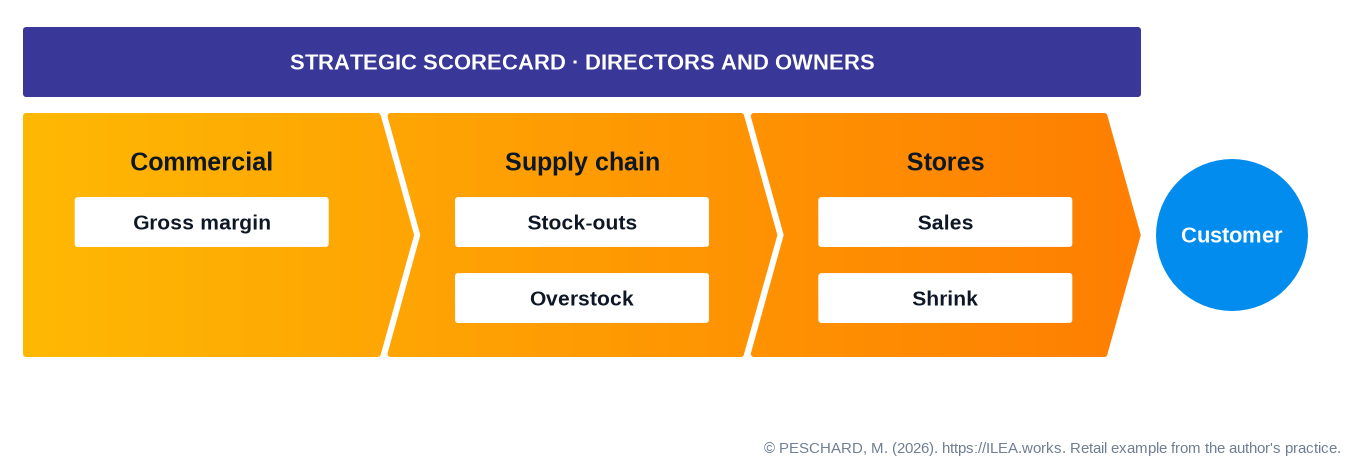
Retail example from the author’s practice.
3. Three levels in cascade. The strategic level, the scorecard, monitors the execution of strategic objectives and is for directors. The tactical level analyzes the performance of each area and its projects and is for managers. The operational level monitors processes day to day and is for teams.[5] Monitoring the performance of their area is a management function: each area has its own tactical and operational KPIs, and each level explains the one above it. Objectives cascade down and results roll up.
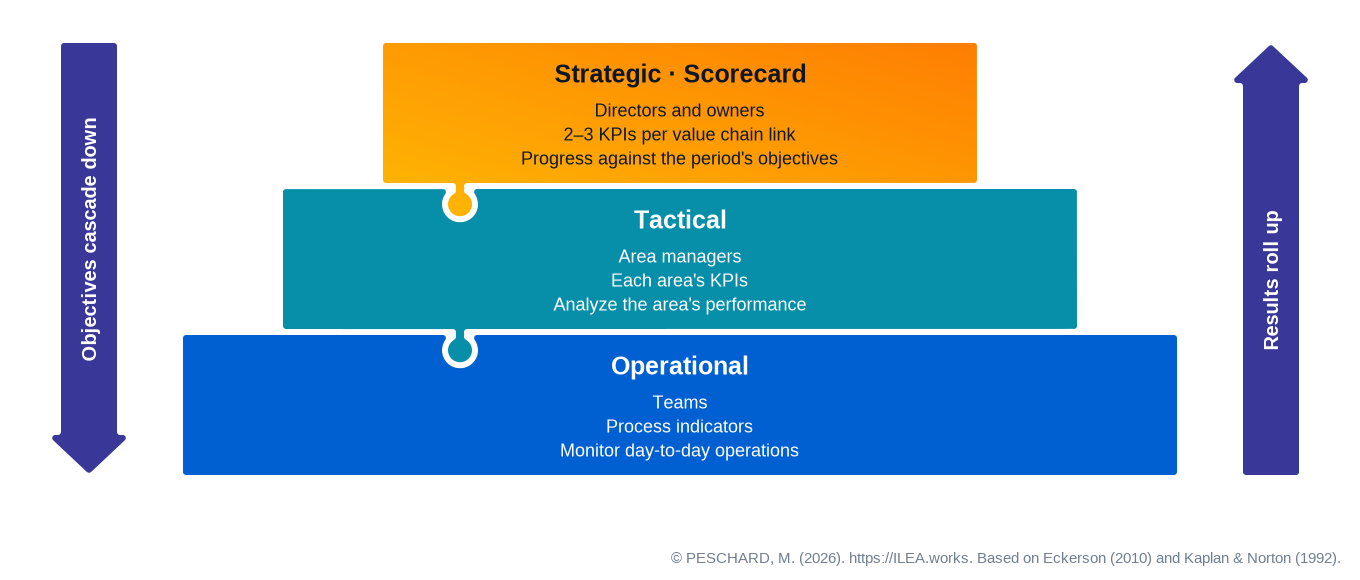
Based on Eckerson (2010) and Kaplan & Norton (1992).[5][1]
4. Balanced. Alongside the outcome indicators (sales, margin) go the ones that drive them (stock-outs, shrink), so the business is not managed only through the rear-view mirror.[1]
5. One single definition. Business defines each KPI: which objective it measures, its target, its period, and its owner. Data certifies it: one single source and one single formula, traceable and reconciled. The three levels are integrated through consistent metric definitions and shared data.[5] See From data to the certified metric.
References
- Kaplan, R. S., & Norton, D. P. (1992). The Balanced Scorecard: Measures That Drive Performance. Harvard Business Review, January–February 1992. https://hbr.org/1992/01/the-balanced-scorecard-measures-that-drive-performance-2
- Peschard, M. (2026). Intelligent & Lean Enterprise Architecture (ILEA), v1.21, §9.1–§9.2 (Business Domain). INDAUTOR Reg. 03-2026-020309540400-01. https://ilea.works/en/
- Doerr, J. (2018). Measure What Matters. Portfolio/Penguin. See also What Matters, OKR meaning, definition and example. https://www.whatmatters.com/faqs/okr-meaning-definition-example
- Peschard, M. (2026). Chapter 2, “Transformación Digital Inteligente,” in GOCHY® Consulting Consortium, GALACRÁCKTICO® El Ejecutivo de 2040: Pensar Futuro. Decidir Hoy.
- Eckerson, W. W. (2010). Performance Dashboards: Measuring, Monitoring, and Managing Your Business (2nd ed.). Wiley.