
Business
Without a model of the current state (as-is), there is no baseline to optimize. That is why process analysis (BPA) and process management (BPM) are indispensable. Done the traditional way, however, covering every process, with long interviews and the full notation, they become slow, and by the time the as-is is finished it has already changed (the author’s experience). ILEA makes them agile: small, data-driven, and purposeful.
The starting point is the BPM lifecycle, which runs from process identification to process monitoring.[1] ILEA compacts it into five steps:
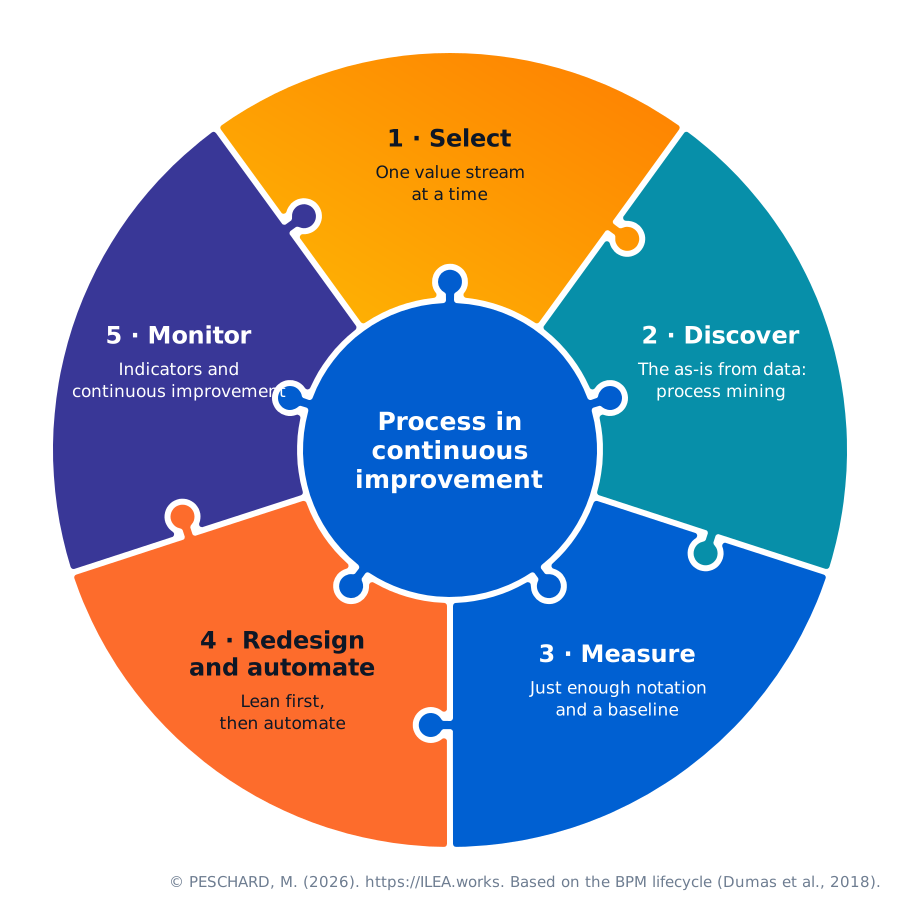
ILEA diagram based on the BPM lifecycle (Dumas et al., 2018).[1]
1. Select: one value stream at a time. Not the whole enterprise, not every process: the one that touches a link of the value chain and where people spend more than half of their time on it, repetitively and daily.[2]
2. Discover: the as-is from data, not only from interviews. Process mining reconstructs the real process from the event logs of the systems.[3] Where there is no data, the team walks the process where it happens and draws the current-state value stream map, with its material and information flows.[4]
3. Measure: just enough notation and a baseline. Model with a purpose and only enough to decide.[5] In practice, less than 20% of the BPMN vocabulary is used regularly, and models share a core of four or five constructs.[6] The baseline is the process indicators: cycle time, handoffs between areas, rework percentage, and cost per transaction.[7]
4. Redesign and automate: Lean first, then automate. Draw the future state without waste,[4] and only then automate and incorporate agents, because automating an inefficient process makes it permanent.[2][8]
5. Monitor: BPM is a cycle, not a project. The process is followed with its indicators, and the cycle starts again when it stops meeting its objectives.[1]
This is how a process climbs the maturity ladder:[9]
- selecting, discovering, and measuring it take it from Ad hoc to Managed;
- connecting it with its systems and data takes it to Integrated;
- redesigning it with a Lean approach and automating it take it to Optimized;
- monitoring it keeps it there.
This correspondence is the author’s adaptation.
ILEA states what process analysis and management must achieve. The detailed method for each organization is not part of ILEA.
References
- Dumas, M., La Rosa, M., Mendling, J., & Reijers, H. A. (2018). Fundamentals of Business Process Management (2nd ed.). Springer.
- Peschard, M. (2026). Chapter 2, “Transformación Digital Inteligente,” in GOCHY® Consulting Consortium, GALACRÁCKTICO® El Ejecutivo de 2040: Pensar Futuro. Decidir Hoy.
- van der Aalst, W. M. P. (2016). Process Mining: Data Science in Action (2nd ed.). Springer. https://link.springer.com/978-3-662-49850-7
- Rother, M., & Shook, J. (1999). Learning to See: Value Stream Mapping to Add Value and Eliminate Muda. Lean Enterprise Institute. https://www.lean.org/store/book/learning-to-see/
- Ambler, S. W. The Principles of Agile Modeling (AM). https://agilemodeling.com/principles/
- zur Muehlen, M., & Recker, J. (2008). How Much Language Is Enough? Theoretical and Practical Use of the Business Process Modeling Notation. In Advanced Information Systems Engineering (CAiSE 2008), 465–479. Springer. https://doi.org/10.1007/978-3-540-69534-9_35
- Peschard, M. (2026). IDT, v1.3, §13 (Lean Process Redesign: indicators).
- Peschard, M. (2026). IDT, v1.3, §13–§15 (Lean Process Redesign, Intelligent Automation, and Governed Digital Agents).
- CMMI Institute. CMMI Levels of Capability and Performance. https://cmmiinstitute.com/learning/appraisals/levels