
Data
Data governance is not about technology; it is about authority over the data and its definition.[1] Without it, users end up “reporting the same metrics but with different results.”[2]
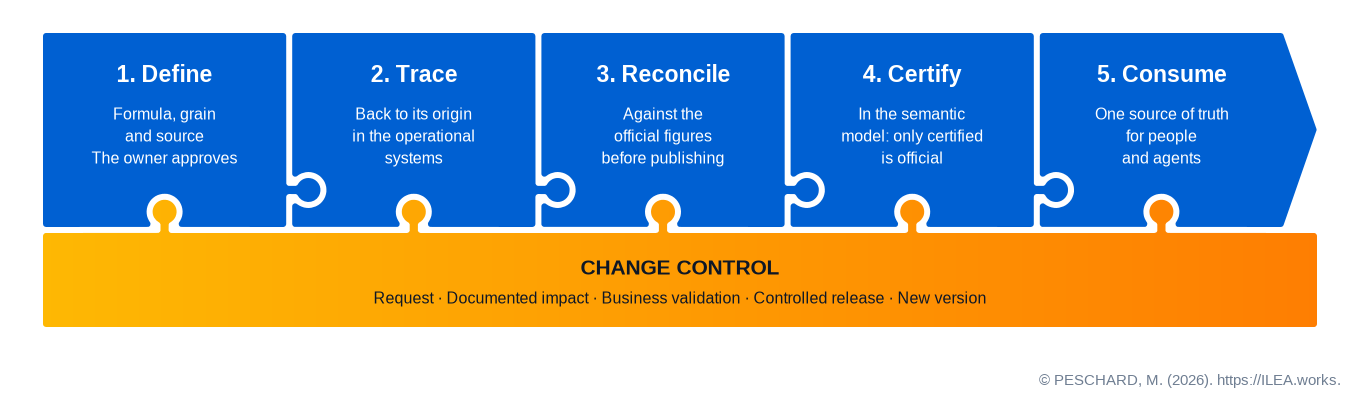
ILEA diagram. Author’s adaptation.[1]
- One source. Official metrics are calculated from the certified model, built on the canonical layer.[1]
- One definition. Each metric has an official, documented definition: formula, grain, and source.[1] The objective it measures, its target, its period, and its owner come from the Business domain: see KPIs and Scorecard.
- Traceable and reconcilable. Each metric can be traced back to its transactional origin and reconciled against the operational systems. Reconciliation is automated: audits compare the source with every layer by total, by period, and by record count.[1]
- A business owner. Each metric has a business owner who validates its definition and how it is interpreted.[1]
- Controlled change. Changing a metric requires a formal request, its documented impact, business validation, a controlled release, and a new version of the model.[1]
| Role | Main responsibility |
|---|---|
| Data owner (business) | Defines and approves the official metrics; answers for the quality of the data and the business decisions about it[1][3] |
| Data steward | Safeguards quality, consistency, and metadata[1][3] |
| Technical owner (data architect) | Safeguards the architecture of the layers and the load processes[1][3] |
| BI administrator | Controls publishing, workspaces, and permissions[1] |
| Internal audit | Oversees traceability and use[1] |
From personal to certified. Not all analytics needs the same governance. Microsoft distinguishes four scopes: personal, team, departmental, and enterprise. Personal content is “intended for use by the creator. Sharing content with others isn’t an objective”; enterprise content “is most often managed by a centralized team and is subject to additional governance requirements.” The more people consume it, the fewer create it: personal analytics has the most creators and the fewest consumers; enterprise analytics, the reverse.[4]
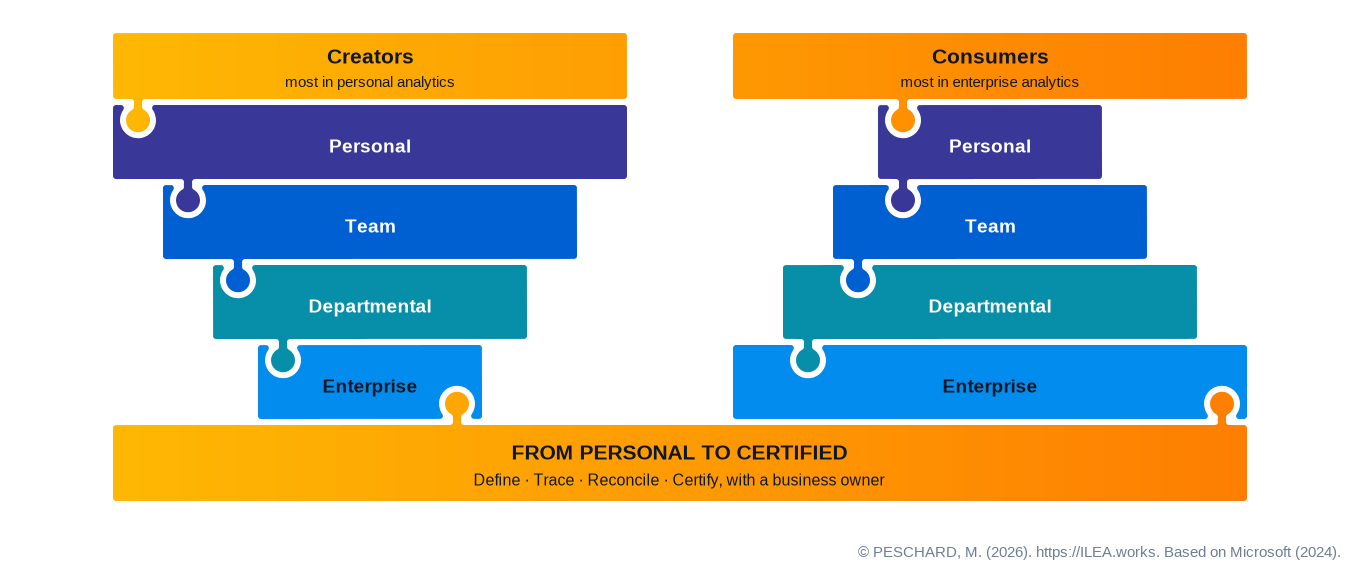
ILEA diagram based on Microsoft (2024).[4]
Microsoft asks whether there are paths for useful self-service content to be “promoted” from personal to team scopes and beyond.[4] BI platforms mark two steps on that path: any content owner can promote content, but only a group of reviewers defined by the administrator can certify it, which means that it “meets the organization’s quality standards.”[5]
In ILEA, personal analytics with AI is done on certified data; when a new metric proves its worth, it follows the path of the certified metric (define, trace, reconcile, certify) with a business owner.[1]
Who sees what is decided by role, not by person, under least privilege and with the segmentation enforced in the semantic model; the controls belong to the Security domain.[6][1]
What is not certified is not official data. The figure is not debated: it is looked up in the certified model.[1]
One governance for data and for AI
An AI model learns from data, reads data, and produces data. Governing AI apart from the data it uses is like inspecting a kitchen without looking at the ingredients. Gartner predicts that by 2027, 60% of organizations will fail to realize value from AI because their data governance and their AI governance are not integrated.[7]
Integrating them means that the same people and the same rules cover both:[1]
- The same owner. The business owner of a piece of data also decides whether an AI agent may use it, and for what.
- The same definitions. AI answers with the certified metrics, not with a calculation of its own, as required by the guardrails.
- The same trail. Which data an agent used can be followed, like the trail of any figure in Data you can trust.
- The same access rules. An agent sees only what the person it works for is allowed to see.
Governance is about people. In a Gartner survey of 223 data and analytics leaders, resistance from the culture of the organization outweighed the lack of funding as the main reason governance initiatives fail. Its advice is to tie governance to business results and to make it a responsibility shared by the business and technology, not a task of the IT area.[8] It is the same principle this page starts with: governance is about authority over the data, and that authority belongs to the business.[1]
The life of data: from creation to deletion
Data has a life: it is created, used, kept, and one day deleted. Managing data means taking care of it through that whole life.[9] Four questions are often left unanswered until there is a problem:[1]
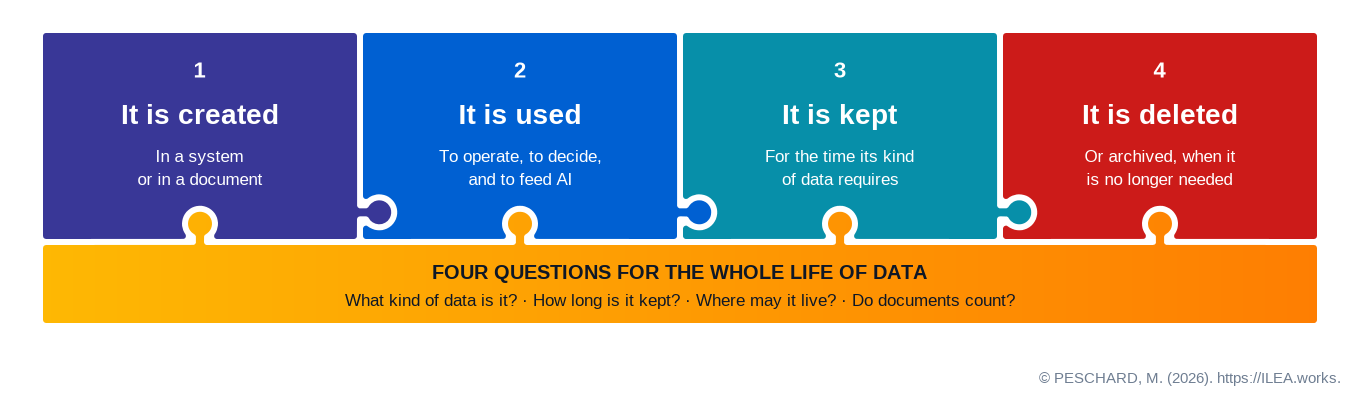
ILEA diagram. Author’s adaptation.[1]
- What kind of data is it? Personal, confidential, or public. The answer decides how it is protected, together with the Security domain.
- How long is it kept? Each kind of data has a time to be kept and a moment to be archived or deleted. Keeping everything forever costs money and adds risk.
- Where may it live? Some data must stay in a country or a region, by law or by contract. That has to be known before choosing where to store it or which AI service will process it.
- Do documents count? Yes. Contracts, emails, and images that AI can now read need the same care as tables: an owner, a classification, a time to be kept, and access rules. Gartner expects 80% of organizations to govern structured and unstructured data with one approach by 2030, driven by AI.[7]
To go deeper
Data governance is the first of the eleven knowledge areas of DAMA-DMBOK, and its 2024 revision integrated the governance and ethics of AI.[10][11] ISO/IEC 38505-1 gives the governing body of an organization principles for the use of data.[12] The CDMC framework of the EDM Association defines 14 key controls for sensitive data in the cloud, among them ownership, data sovereignty, and retention.[13] In the European Union, the AI Act requires high-risk AI systems to be developed on training, validation, and testing data that meet quality criteria; after its 2026 amendment, that obligation applies from December 2, 2027, for the systems listed in its Annex III.[14][15]
References
- Author’s adaptation, from the author’s practice designing and implementing data platforms.
- Microsoft. (2025, April 11). Online Analytical Processing. Azure Architecture Center. https://learn.microsoft.com/en-us/azure/architecture/data-guide/relational-data/online-analytical-processing
- Amazon Web Services. (n.d.). Roles and responsibilities. In Strategies for building a data mesh-based enterprise solution on AWS. AWS Prescriptive Guidance. https://docs.aws.amazon.com/prescriptive-guidance/latest/strategy-data-mesh/roles-responsibilities.html
- Microsoft. (2024, December 30; updated 2026, April 28). Microsoft Fabric adoption roadmap: Content delivery scope. https://learn.microsoft.com/en-us/power-bi/guidance/fabric-adoption-roadmap-content-delivery-scope
- Microsoft. (2025, October 1). Promote and Certify Power BI Content with Endorsement. https://learn.microsoft.com/en-us/power-bi/collaborate-share/service-endorsement-overview
- Peschard, M. (2026). Intelligent & Lean Enterprise Architecture (ILEA), v1.21, §13.1–§13.2 (Data Domain). INDAUTOR Reg. 03-2026-020309540400-01. https://ilea.works/en/
- Gartner. (2026, October 28). Data Is Stepping Out of AI’s Shadow. https://www.gartner.com/en/articles/data-and-analytics-ai-success
- Gartner. (2026, September 21). Gartner Predicts 60% of Organizations That Ignore Data Governance Culture Challenges Will Fail to Govern AI Successfully by 2027 [Press release]. https://www.gartner.com/en/newsroom/press-releases/2026-09-21-gartner-predicts-60-percent-of-organizations-that-ignore-data-governance-culture-challenges-will-fail-to-govern-ai-successfully-by-2027
- DAMA International. (n.d.). What is Data Management? https://dama.org/about-dama/what-is-data-management/
- DAMA International. (n.d.). DAMA-DMBOK Framework. https://www.damadmbok.org/dmbok-framework
- DAMA International. (2024). DAMA DMBOK Revision. https://dama.org/dama-dmbok-revision/
- ISO/IEC. (2026). ISO/IEC 38505-1:2026, Information technology — Governance of data — Part 1: Application of ISO/IEC 38500 to the governance of data. https://www.iso.org/standard/87195.html
- EDM Association. (2021). Cloud Data Management Capabilities (CDMC), v1.1. EDM Council. https://edmcouncil.org/frameworks/cdmc/
- European Union. (2024). Regulation (EU) 2024/1689 of the European Parliament and of the Council of 13 June 2024 laying down harmonised rules on artificial intelligence (Artificial Intelligence Act), Article 10. https://eur-lex.europa.eu/eli/reg/2024/1689/oj/eng
- European Union. (2026). Regulation (EU) 2026/1744 of the European Parliament and of the Council of 8 July 2026 amending Regulations (EU) 2024/1689, (EU) 2018/1139 and (EU) 2023/1230 as regards the simplification of the implementation of harmonised rules on artificial intelligence (Digital Omnibus on AI). https://eur-lex.europa.eu/eli/reg/2026/1744/oj/eng