
Data
A data mart that only its builder understands is like merchandise in the back room: it exists, but nobody can buy it. A data product is the same data on the shelf: easy to find, with its label, with someone who answers for it, and with a promise of what the buyer gets.[1] The idea comes from Zhamak Dehghani, who proposed treating data as a product and the people who use it as customers.[2] Thoughtworks recommends it as the default way of managing data, whatever the architecture.[3]
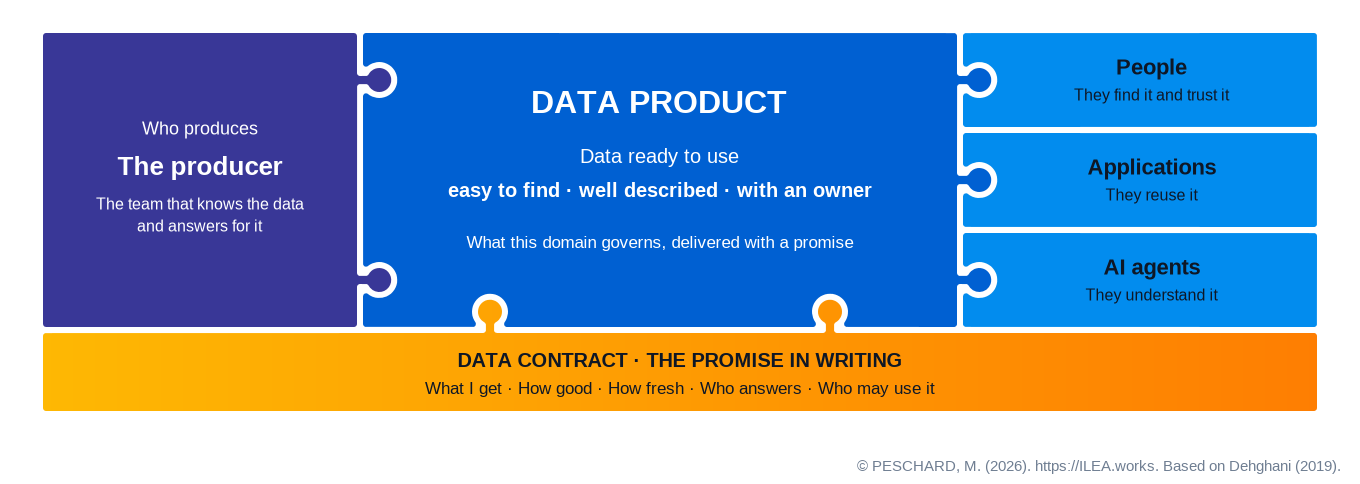
ILEA diagram. Author’s adaptation, based on Dehghani (2019).[2]
What makes data a product
Dehghani lists six qualities. Each one answers a question of the person who wants to use the data:[2]
| Quality | The question | Where ILEA covers it |
|---|---|---|
| Discoverable | Can I find it? | The data catalog, in Data you can trust |
| Addressable | Is it always in the same place? | The certified semantic model, in Data layers for analytics |
| Trustworthy | Can I believe it? | Quality checks and certification, in From data to certified metric |
| Self-describing | Does it explain itself? | The data dictionary |
| Interoperable | Does it combine with other data? | The canonical model and master data |
| Secure | Who may see it? | Access rules, governed with the Security domain |
Qualities: Dehghani (2019).[2] Questions and the ILEA column: author’s adaptation.[1]
The table shows something encouraging: a data product is not a new thing to build. It is what this domain already governs, delivered with an owner and a promise.[1]
The data contract: the promise in writing
A product on the shelf comes with a guarantee. For data, that guarantee is the data contract: an agreement between whoever produces the data and whoever uses it.[4] In plain words, it answers five questions:
- What do I get? The tables and fields, and what each one means.
- How good is it? The quality rules it must pass.
- How fresh is it? How often it is updated and when it is ready.
- Who answers for it? The owner, and where to ask for help.
- Who may use it? The roles that have access.
Questions: author’s adaptation of the sections of the Open Data Contract Standard.[4][1]
The value is that the contract is written so that a machine can check it. Each time data arrives, the checks described in Data you can trust run against the contract, and a broken promise is detected before the consumer finds it.[1] Gartner predicts that by 2030 half of organizations will use AI agents to turn their governance policies and technical standards into data contracts that a machine can verify.[5]
Two contracts, one meaning. The Integration domain also has a contract: the one that describes an exchange between applications, what can be asked and what comes back, in The contract. The data contract describes a set of data delivered for analysis and for AI: what it contains, how good it is, and how fresh. Both take their meaning from the same canonical model.[1]
Start small, with a real use
Gartner’s advice is to start with the uses that matter most to the business, deliver small products that can be reused and combined, and agree with the consumers how success will be measured.[6] The warning is just as clear: Gartner predicts that by 2027, 75% of data and analytics products will be made redundant, or their marketplaces shut down, because too few people used them.[7] A data product nobody uses is not a product.
In ILEA the first data products are usually already there: the certified data marts and the semantic model, which have an owner and a certified definition. What is missing is to write down the promise.[1]
With AI
An AI agent is one more customer, and a demanding one: it cannot ask a colleague what a column means or whether yesterday’s load arrived. The data product tells it, through its description and its contract. That is why data products are a natural way to feed the context layer.[1]
To go deeper
Data as a product is one of the four principles of data mesh, together with ownership by domain, a self-serve data platform, and federated governance.[8] The Open Data Contract Standard (ODCS), version 3.2.0, is maintained by Bitol, a project of the LF AI & Data Foundation, which also publishes a standard for describing data products.[4][9]
Next: Data you can trust: metadata, lineage, and quality
References
- Author’s adaptation, from the author’s practice designing and implementing data platforms.
- Dehghani, Z. (2019, May 20). How to Move Beyond a Monolithic Data Lake to a Distributed Data Mesh. martinfowler.com. https://martinfowler.com/articles/data-monolith-to-mesh.html
- Thoughtworks. (2025, April 2). Data product thinking. Technology Radar. https://www.thoughtworks.com/radar/techniques/data-product-thinking
- Bitol. (2026). Open Data Contract Standard (ODCS), v3.2.0. LF AI & Data Foundation. https://bitol-io.github.io/open-data-contract-standard/latest/
- Gartner. (2026, March 11). Gartner Announces Top Predictions for Data and Analytics in 2026 [Press release]. https://www.gartner.com/en/newsroom/press-releases/2026-03-11-gartner-announces-top-predictions-for-data-and-analytics-in-2026
- Gartner. (2025, March 5). Gartner Identifies Top Trends in Data and Analytics for 2025 [Press release]. https://www.gartner.com/en/newsroom/press-releases/2025-03-05-gartner-identifies-top-trends-in-data-and-analytics-for-2025
- Gartner. (2025, March 5). Gartner Data & Analytics Summit 2025 Orlando: Day 3 Highlights [Press release]. https://www.gartner.com/en/newsroom/press-releases/2025-03-05-gartner-data-and-analytics-summit-2025-orlando-day-3-highlights
- Dehghani, Z. (2020, December 3). Data Mesh Principles and Logical Architecture. martinfowler.com. https://martinfowler.com/articles/data-mesh-principles.html
- Bitol. (n.d.). Bitol. LF AI & Data Foundation. https://bitol.io/