
Data
Structured data lives in two families of databases built for opposite purposes. Transactional databases (OLTP) record the business as it happens: many small writes, normalized data, and strong consistency. Analytical databases (OLAP) explain it: they read a lot, write little, keep history, and organize data in star or snowflake schemas.[1][2] The ERP is designed to execute processes and record transactions; analytics needs a model designed to decide and explain the business, not to operate it.[3] Running heavy analytics on the transactional database slows down the operation itself,[1] so the analytical copy exists for deciding not to get in the way of operating.
Beyond the relational, a single store rarely serves every access pattern: most production systems combine several models, which Microsoft calls polyglot persistence.[4]
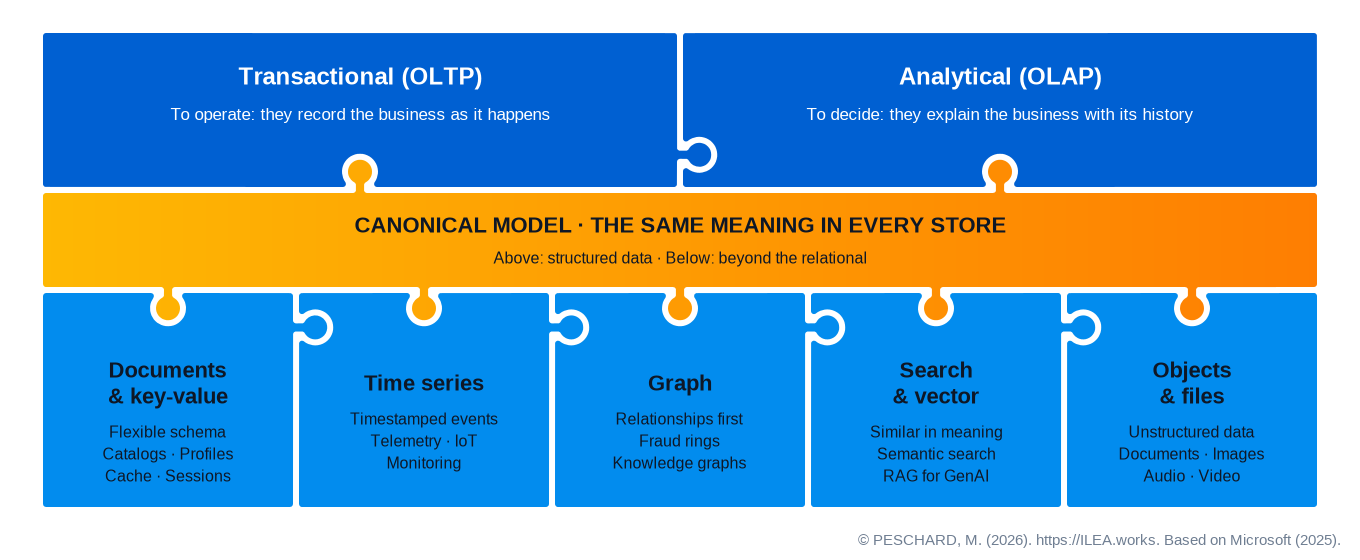
ILEA diagram based on Microsoft’s classification of data store models.[4]
- Graph, when relationships matter most. Nodes and edges answer questions of variable depth: fraud rings, knowledge graphs, supply chain dependencies.[4]
- Vector, when meaning matters. Vector stores find what is similar in meaning, not only in words.[4] They are the basis of retrieval-augmented generation (RAG), which grounds GenAI’s answers in the organization’s own content.[5]
- Objects and files, for the unstructured. Documents, images, audio, and video live in object storage, which is also the raw zone of the data lake.[4] AI can now read them: an AI assistant that read notarial documents, extracted the data, and left it ready for review cut capture time to a third from the first week.[6]
The shape changes; the meaning does not. A customer is the same customer in the transactional table, the star schema, the graph, and the vector index: the canonical model applies to every store.[3]
Next: Data layers for analytics
References
- Microsoft. (2026, February 6). Online Transaction Processing (OLTP). Azure Architecture Center. https://learn.microsoft.com/en-us/azure/architecture/data-guide/relational-data/online-transaction-processing
- Microsoft. (2025, April 11). Online Analytical Processing. Azure Architecture Center. https://learn.microsoft.com/en-us/azure/architecture/data-guide/relational-data/online-analytical-processing
- Author’s adaptation, from the author’s practice designing and implementing data platforms.
- Microsoft. (2025, August 21). Understand Data Models. Azure Architecture Center. https://learn.microsoft.com/en-us/azure/architecture/data-guide/technology-choices/understand-data-store-models
- Microsoft. (2026, August 4). RAG and Generative AI: Azure AI Search. https://learn.microsoft.com/en-us/azure/search/retrieval-augmented-generation-overview
- Peschard, M. (2026). Chapter 2, “Transformación Digital Inteligente,” in GOCHY® Consulting Consortium, GALACRÁCKTICO® El Ejecutivo de 2040: Pensar Futuro. Decidir Hoy.