
Data
Before buying a packaged product, you read its label: what it is, where it comes from, and its expiry date. A figure deserves the same. It can be trusted when three questions have an answer: what it means, where it comes from, and how good it is.[1]
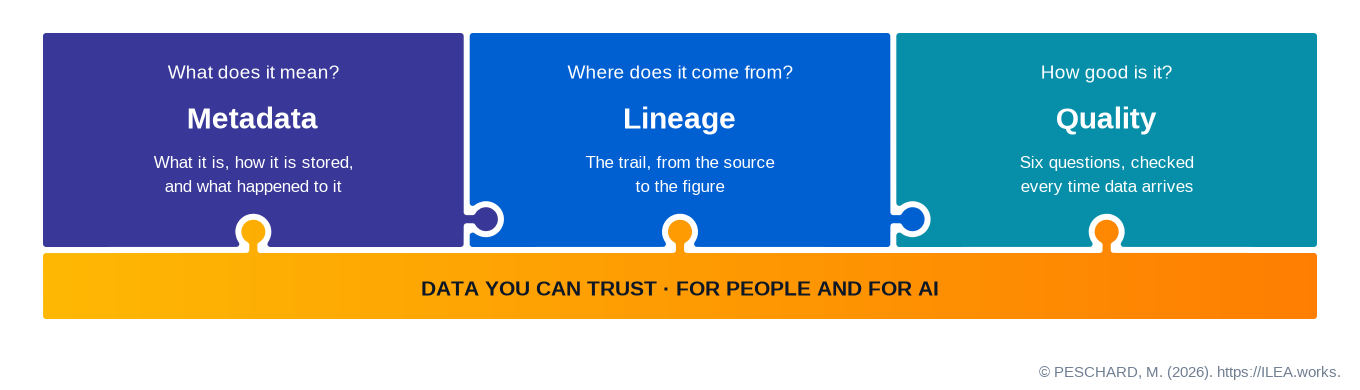
ILEA diagram. Author’s adaptation.[1]
Metadata: the label
Metadata is the information that describes the data.[2] A good label says three things:[1]
- What it means. What the data is, how it is calculated, and who answers for it. This lives in the data dictionary.
- How it is stored. In which system and in what form.
- What happened to it. When it arrived, from which system, and how many records came in or were rejected. This lives in the load log.
Write the dictionary on the canonical layer. That is where the names are already clear and each piece of data has one meaning. People read that dictionary, and so do AI agents: Microsoft recommends adding descriptions to tables and columns,[3] and notes that preparing the data this way gives the AI the context it needs to reduce ambiguity.[4] In the author’s practice, the dictionary of each term is the first piece of the context given to an agent.[5]
Gartner recommends starting with how the data is stored and then adding what it means, and keeping that information alive: not a document someone updates by hand, but something the systems keep up to date.[6][7]
A label nobody can find is useless. The data catalog is the one place where people, and now AI agents, look up what data exists, what it means, and who owns it. Metadata is also one of the four pieces of the context layer.[1]
Lineage: the trail
Lineage is the trail a piece of data leaves, from the system where it was born to the figure someone reads. Three habits keep that trail intact:[1]
- Every record remembers where it came from: which system, and when it was loaded.
- Every step says where it reads from, from the first copy of the source data to the model people consult, as described in Data layers for analytics.
- Every official figure can be followed back to the original transactions, as required in From data to certified metric.
With AI the trail matters even more. An answer that says where its figure comes from can be checked; one that does not can only be believed.[1]
Quality: the inspection
Quality is measured, not assumed. Six questions cover it:[8]
| Dimension | The question | An example |
|---|---|---|
| Completeness | Is everything that should be there, there? | Every sale has a store and a date |
| Uniqueness | Is anything recorded twice? | Each customer appears only once |
| Consistency | Does anything contradict something else? | The lines of an invoice add up to its total |
| Timeliness | Is it up to date? | Yesterday’s sales are ready before the day starts |
| Validity | Does it have the expected form? | Dates are real dates |
| Accuracy | Does it match reality? | The month’s sales match the system of origin |
Dimensions: UK Government (2020), as defined by DAMA UK.[8] Questions and examples: author’s adaptation.[1]
Four habits keep quality under control:[1]
- Check every time data arrives, at the step where the problem can be fixed.
- Keep what was rejected, with the reason. A rejected record is not thrown away in silence: it is also information.
- Show the date of the last update next to the figure, so that nobody decides on old data without knowing it.
- Compare against the systems of origin. This is part of the certified metric.
Together, these habits let the data team know that something broke before the business finds out. The industry calls this data observability.[7]
To go deeper
These three topics are established disciplines. DAMA-DMBOK treats metadata and data quality as two of its eleven knowledge areas.[2] ISO standardizes data quality in the ISO 8000 series,[9] in ISO/IEC 25012,[10] and, for analytics and machine learning, in ISO/IEC 5259.[11] There are open standards for data catalogs, W3C DCAT,[12] and for lineage, OpenLineage.[13] The TOGAF Standard has a series guide on metadata management,[14] and NIST describes how to track the origin of the data used by generative AI.[15]
Next: From data to certified metric (governance)
References
- Author’s adaptation, from the author’s practice designing and implementing data platforms.
- DAMA International. (n.d.). DAMA-DMBOK Framework. https://www.damadmbok.org/dmbok-framework
- Microsoft. (2026, July 6). Optimize Your Semantic Model for Copilot in Power BI. Microsoft Learn. https://learn.microsoft.com/en-us/power-bi/create-reports/copilot-evaluate-data
- Microsoft. (2026, May 26). Prepare Your Data for AI to Improve Copilot Results (Preview). Microsoft Learn. https://learn.microsoft.com/en-us/power-bi/create-reports/copilot-prepare-data-ai
- Peschard, M. (2026). Chapter 2, “Transformación Digital Inteligente,” in GOCHY® Consulting Consortium, GALACRÁCKTICO® El Ejecutivo de 2040: Pensar Futuro. Decidir Hoy.
- Gartner. (2025, March 5). Gartner Identifies Top Trends in Data and Analytics for 2025 [Press release]. https://www.gartner.com/en/newsroom/press-releases/2025-03-05-gartner-identifies-top-trends-in-data-and-analytics-for-2025
- Gartner. (2025, February 26). Lack of AI-Ready Data Puts AI Projects at Risk [Press release]. https://www.gartner.com/en/newsroom/press-releases/2025-02-26-lack-of-ai-ready-data-puts-ai-projects-at-risk
- Government Data Quality Hub. (2020, December 3). The Government Data Quality Framework. GOV.UK. https://www.gov.uk/government/publications/the-government-data-quality-framework/the-government-data-quality-framework
- International Organization for Standardization. (2022). ISO 8000-1:2022, Data quality — Part 1: Overview. https://www.iso.org/standard/81745.html
- ISO/IEC. (2008). ISO/IEC 25012:2008, Software engineering — Software product Quality Requirements and Evaluation (SQuaRE) — Data quality model. https://www.iso.org/standard/35736.html
- ISO/IEC. (2024). ISO/IEC 5259-1:2024, Artificial intelligence — Data quality for analytics and machine learning (ML) — Part 1: Overview, terminology, and examples. https://www.iso.org/standard/81088.html
- World Wide Web Consortium. (2024, August 22). Data Catalog Vocabulary (DCAT) - Version 3. W3C Recommendation. https://www.w3.org/TR/vocab-dcat-3/
- OpenLineage. (n.d.). About OpenLineage. LF AI & Data Foundation. https://openlineage.io/docs/
- The Open Group. (2023, April 11). TOGAF® Series Guide: Information Architecture: Metadata Management (G234). https://publications.opengroup.org/g234
- National Institute of Standards and Technology. (2024, July). Artificial Intelligence Risk Management Framework: Generative Artificial Intelligence Profile (NIST AI 600-1). https://doi.org/10.6028/NIST.AI.600-1