
Data
First the floor, then the agent. The obvious temptation is to connect an agent straight to the ERP. In the author’s experience with a wholesaler, the agent came only after a data platform had consolidated the ERP into an analytical model, and only once that analytics was validated.[1]
The context layer
A language model can read a table; what it cannot read is what the business means by it. That meaning is what the context layer provides: one place where every person and every AI agent finds the same definitions, the same formulas, and the same rules.[2] Gartner advises building it as a core part of the data infrastructure, because a description of tables and columns does not carry the meaning of the business,[3] and predicts that by 2030 it will be treated as critical infrastructure, alongside data platforms and cybersecurity.[4]
In ILEA the context layer is not a new product. It is what this domain already governs, put together: the canonical model, which says what each thing is; the certified metrics, which say how each figure is calculated; the business rules and guardrails, which say how to calculate and what not to do; and the metadata, which says where each figure comes from.[2]
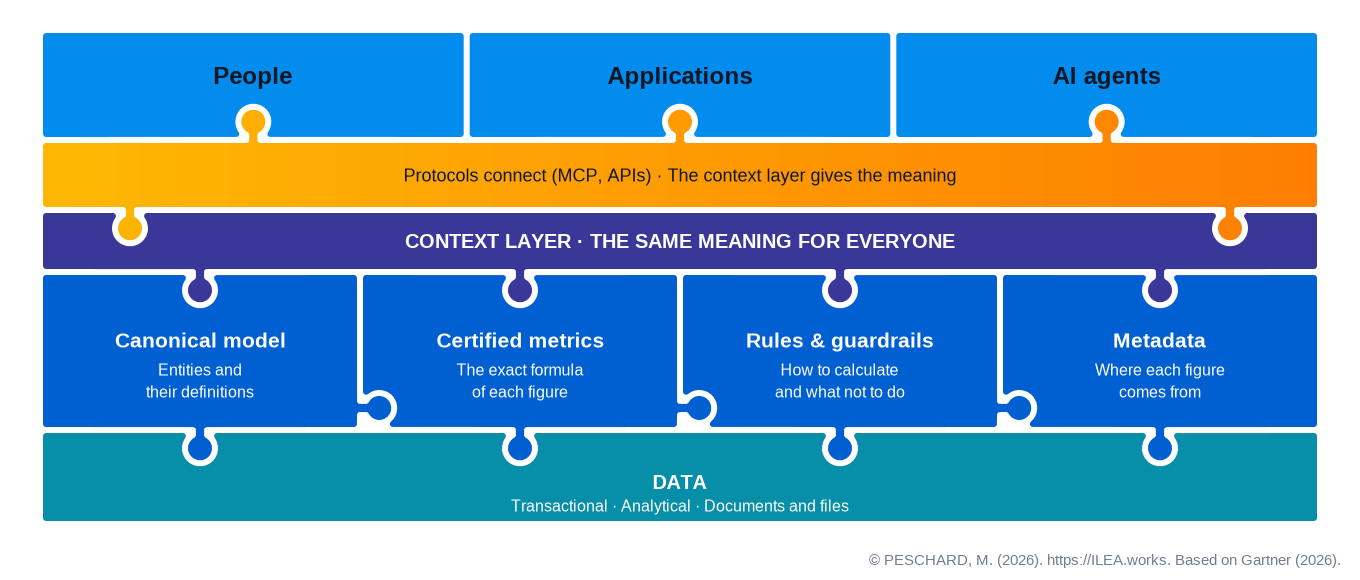
ILEA diagram. Author’s adaptation, based on Gartner (2026).[3]
The plug is not the meaning. There are now standard ways to connect an AI agent to the company’s data, such as the Model Context Protocol.[5] They work like a plug: they let the agent reach the data, but they do not tell it what “active customer” means. According to Gartner, 60% of the analytics projects with agents that rely on that connection alone will fail, because they lack a consistent layer of meaning.[6]
What goes into the context
Deciding what an AI agent gets to know before it answers has become a discipline of its own: context engineering.[7][8] The Data domain provides the governed content of that context; the Agents domain decides how each agent uses it.[2]
Context makes an agent reliable, not the model. The agent was built on the Model Context Protocol (MCP), an open standard for connecting AI applications to external systems such as databases.[5][1] What made it trustworthy was about 600 lines of business rules: the dictionary of each term, the exact formula of each figure, what is included and excluded (always saying so), how to compare fairly, and guards against inventing data. The company’s future objectives belong in that context too: when the agent knows where the business is going, it stops describing and starts answering with judgment.[1] That context is what the Data domain governs: canonical definitions and certified formulas.[9][2]
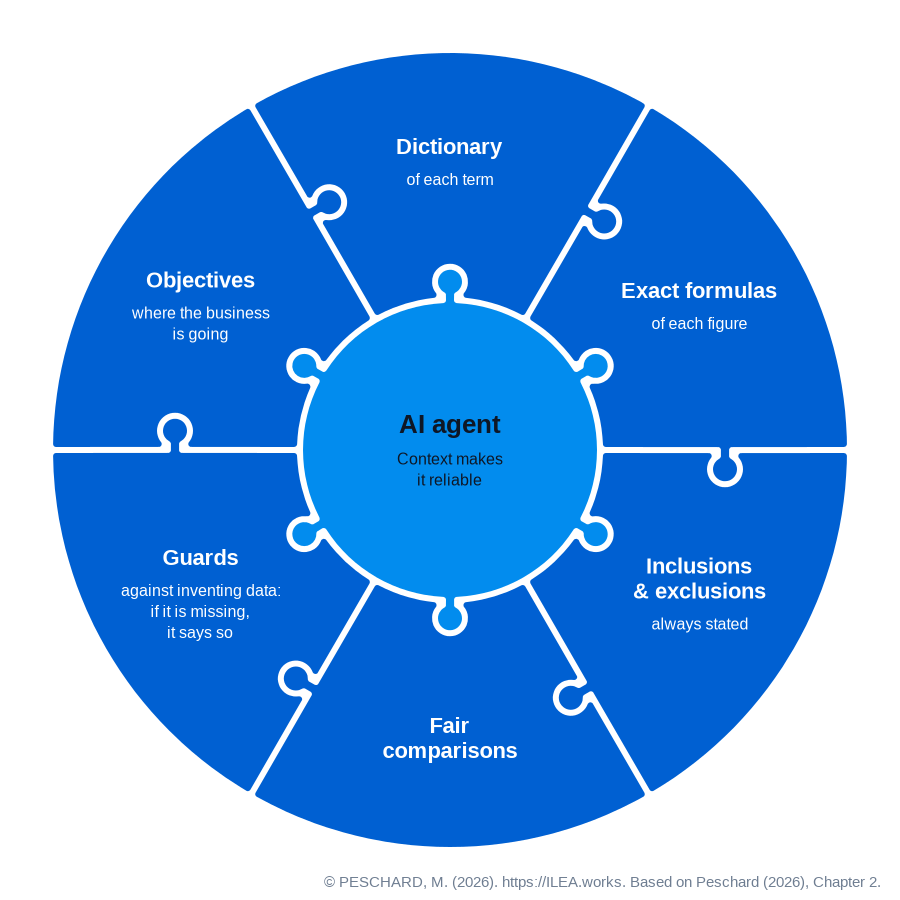
ILEA diagram based on Peschard (2026), Chapter 2.[1]
Semantics pays off. Gartner predicts that by 2027, organizations that prioritize semantics in AI-ready data will increase their GenAI model accuracy by up to 80% and reduce costs by up to 60%, because “poor semantics in GenAI lead to greater hallucinations.”[10] In 2026 Gartner restated the prediction for agentic AI.[3]
Guardrails
Rules say how; guardrails say what not to do. Business rules tell the AI how to calculate; guardrails tell it what it must not do. Without them, AI fills the gaps with whatever “sounds reasonable.” Five guardrails for analytics with AI:[11]
1. Only the certified source. Every number, name, or category comes from the certified data: not from other sources, the model’s general knowledge, or examples.
2. Do not invent. If the question asks for something the data does not contain, say so and leave it out; do not estimate it.
3. Do not adjust figures. If a control figure does not reconcile, do not force it: explain the difference.
4. Every figure is traceable. Each indicator states the columns and filters it comes from, and a script reproduces it end to end.
5. Facts apart from interpretations. Separate what the data says from its reading; any proposed “why” is marked as a hypothesis.
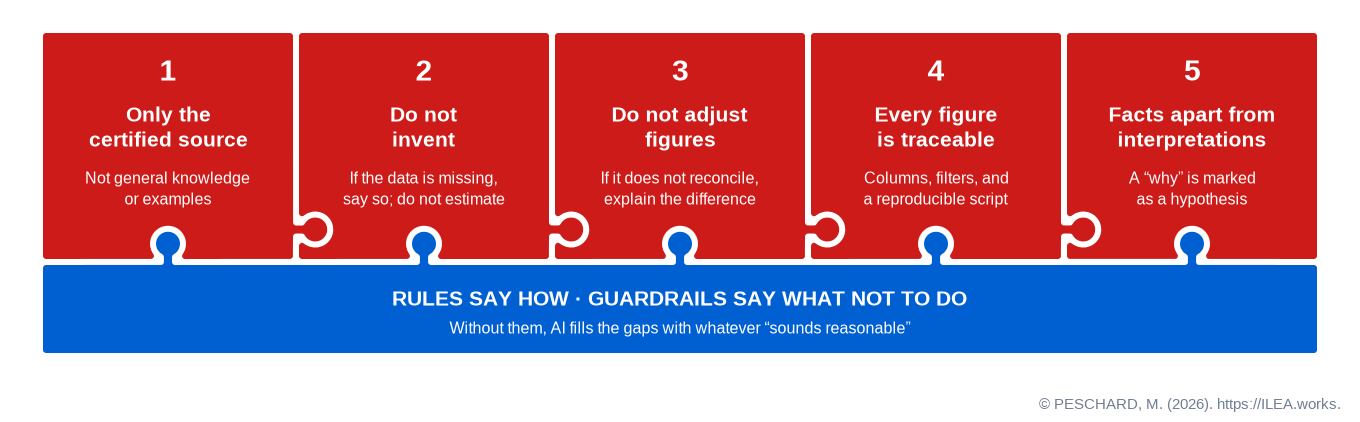
ILEA diagram. Author’s adaptation.[11]
In a training workshop with a fictitious chain and synthetic data, the AI is asked about the cost of tariffs on imported items. The certified data does not contain tariffs, so the expected answer is that it does not have that data.[11]
Data ready for AI
Data is not ready for AI in general; it is ready for a specific use. For Gartner, being ready means that the data represents the real situation the AI will face, including its errors and rare cases, and that proving it is a habit, not a one-time project. The stakes are high: Gartner predicts that through 2026 organizations will abandon 60% of the AI projects that lack such data.[12] It also finds that the organizations that succeed with AI invest up to four times more in foundations such as data quality and governance.[13]
In ILEA this is the analytics ladder read from the data side: each rung states the data it needs before the next one is attempted.[2]
Knowledge graphs: when the question is about the whole
The usual way to give documents to an AI is to let it search for the passages that resemble the question. It works for specific questions and fails for questions about the whole, such as the main themes across all the documents, because those require summarizing, not searching.[14] The answer is to first build a map of who is who and how things relate, a knowledge graph, and let the AI use that map. The technique is known as GraphRAG, and Gartner expects 40% of enterprises to have used it by 2029.[15]
The canonical model is the natural starting point for that map: the same things and relationships the business already defined. The stores for graphs are described in Where data lives.[2]
Verification and access
Every figure, computed two ways. Each number the agent gave was checked against the BI model: the same data, calculated in two independent ways.[1]
Only authorized content. Opening private content to GenAI requires granular access control: “Users and agents must only retrieve authorized content.”[16]
To go deeper
Anthropic defines context engineering as the strategies for curating and maintaining the best possible information available to a model while it works,[7] and Gartner recommends governing context across data sources, knowledge graphs, and policies.[8] Gartner also advises redesigning the data architecture so that AI agents draw their trusted intelligence from the context layer.[13] The Model Context Protocol has been governed under the Linux Foundation since December 2025.[17] Apache Ossie (incubating), formerly Open Semantic Interchange, is an industry effort to standardize how meaning is exchanged between analytics, AI, and BI tools; its specification is still a draft.[18] GraphRAG was introduced by Microsoft Research.[14]
References
- Peschard, M. (2026). Chapter 2, “Transformación Digital Inteligente,” in GOCHY® Consulting Consortium, GALACRÁCKTICO® El Ejecutivo de 2040: Pensar Futuro. Decidir Hoy.
- Author’s adaptation, from the author’s practice designing and implementing data platforms.
- Gartner. (2026, May 11). Gartner Says Lack of Semantics Causes Inaccurate AI Agents and Wasted Spending [Press release]. https://www.gartner.com/en/newsroom/press-releases/2026-05-11-gartner-says-lack-of-semantics-causes-inaccurate-artificial-intelligence-agents-and-wasted-spending
- Gartner. (2026, March 11). Gartner Announces Top Predictions for Data and Analytics in 2026 [Press release]. https://www.gartner.com/en/newsroom/press-releases/2026-03-11-gartner-announces-top-predictions-for-data-and-analytics-in-2026
- Model Context Protocol. (n.d.). What is the Model Context Protocol (MCP)? https://modelcontextprotocol.io/docs/getting-started/intro
- Gartner. (2026, October 28). Data Is Stepping Out of AI’s Shadow. https://www.gartner.com/en/articles/data-and-analytics-ai-success
- Anthropic. (2025, September 29). Effective context engineering for AI agents. https://www.anthropic.com/engineering/effective-context-engineering-for-ai-agents
- Litan, A. (2025, October 6). Context Engineering Is the New Prompt Engineering. Gartner. https://www.gartner.com/en/articles/context-engineering
- Peschard, M. (2026). Intelligent & Lean Enterprise Architecture (ILEA), v1.21, §13.1–§13.2 (Data Domain). INDAUTOR Reg. 03-2026-020309540400-01. https://ilea.works/en/
- Gartner. (2025, June 17). Gartner Announces the Top Data & Analytics Predictions [Press release]. https://www.gartner.com/en/newsroom/press-releases/2025-06-17-gartner-announces-top-data-and-analytics-predictions
- Author’s adaptation, from the author’s training workshop with Abarrotes ACME, a fictitious retail chain with synthetic data (2026).
- Gartner. (2025, February 26). Lack of AI-Ready Data Puts AI Projects at Risk [Press release]. https://www.gartner.com/en/newsroom/press-releases/2025-02-26-lack-of-ai-ready-data-puts-ai-projects-at-risk
- Gartner. (2026, April 16). Gartner Says Organizations with Successful AI Initiatives Invest Up to Four Times More in Data and Analytics Foundations [Press release]. https://www.gartner.com/en/newsroom/press-releases/2026-04-16-gartner-says-organizations-with-successful-ai-initiatives-invest-up-to-four-times-more-in-data-and-analytics-foundations
- Edge, D., Trinh, H., Cheng, N., Bradley, J., Chao, A., Mody, A., Truitt, S., Metropolitansky, D., Ness, R. O., & Larson, J. (2024). From Local to Global: A Graph RAG Approach to Query-Focused Summarization. arXiv:2404.16130. https://arxiv.org/abs/2404.16130
- Gartner. (2026, June 16). Gartner Identifies the Top Trends for Data and Analytics [Press release]. https://www.gartner.com/en/newsroom/press-releases/2026-06-16-gartner-identifies-the-top-trends-for-data-and-analytics
- Microsoft. (2026, August 4). RAG and Generative AI: Azure AI Search. https://learn.microsoft.com/en-us/azure/search/retrieval-augmented-generation-overview
- Linux Foundation. (2025, December 9). Linux Foundation Announces the Formation of the Agentic AI Foundation (AAIF), Anchored by New Project Contributions Including Model Context Protocol (MCP), goose and AGENTS.md [Press release]. https://www.linuxfoundation.org/press/linux-foundation-announces-the-formation-of-the-agentic-ai-foundation
- Apache Software Foundation. (2026). Apache Ossie (incubating). https://ossie.apache.org/ Incubation status: https://incubator.apache.org/projects/ossie.html