
Data
Ackoff ordered what the mind holds in a hierarchy: data, information, knowledge, understanding, and wisdom.[1] For the Data domain, the first three are enough:
- Data: “symbols that represent properties of objects, events and their environments.”[1]
- Information: data processed into an answer to a question, the kind that begins with who, what, when, where, or how many.[1]
- Knowledge: “know-how, for example, how a system works.”[1]
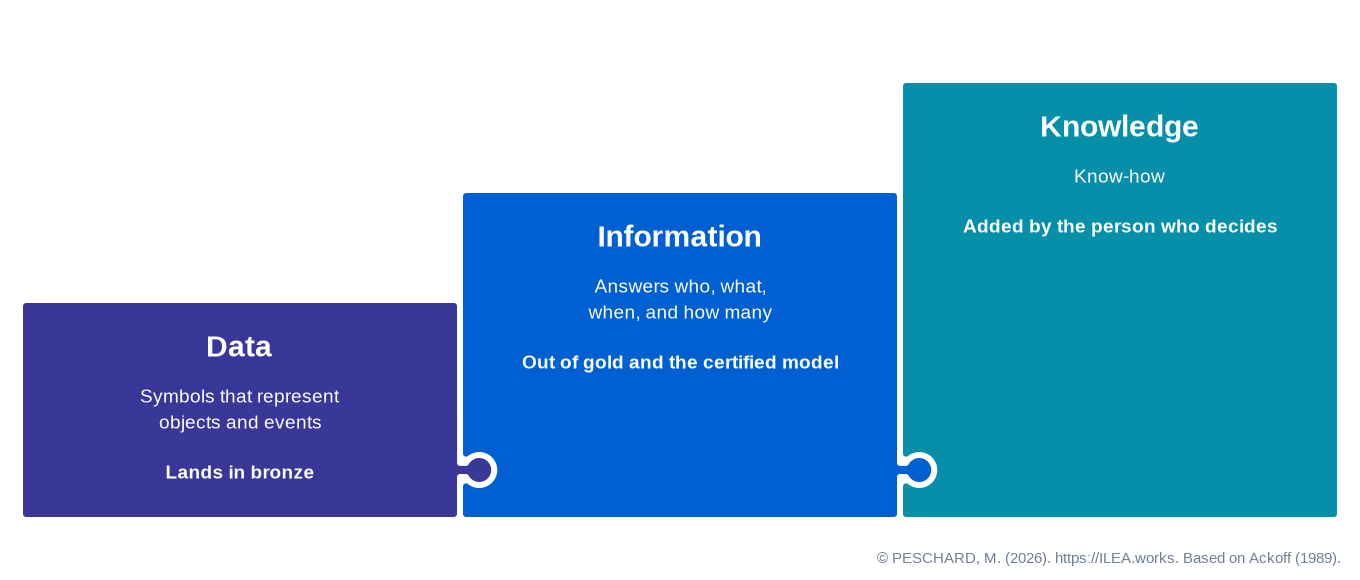
ILEA diagram based on Ackoff (1989).[1]
In the data layers. Data arrives in the landing layer, the bronze of the medallion architecture; information comes out of the data marts, the gold, and the certified semantic model; knowledge is added by the person who decides. Each rung of the analytics ladder asks a new question of that information.[2] Judgment stays human, as the Business domain designs it: see Work design: purpose and tasks.
A teaching model, not a law. DIKW is useful for explaining the path from data to decision, but it has critics: Frické finds it “naïve and problematic,” among other reasons because data are not a purely observational base and know-how resists being written down as rules.[3]
Next: The analytics ladder: what data each rung needs
References
- Ackoff, R. L. (1989). From Data to Wisdom. Journal of Applied Systems Analysis, 16, 3–9. Cited in Frické (2018).
- Author’s adaptation, from the author’s practice designing and implementing data platforms.
- Frické, M. (2018). Data-Information-Knowledge-Wisdom (DIKW) Hierarchy. In ISKO Encyclopedia of Knowledge Organization. https://www.isko.org/cyclo/dikw