
Data
GenAI does not understand tables or databases; it understands meaning. Canonical models are the language of the business for AI.[1] A canonical model defines each business entity once (its name, definition, attributes, and relationships), independent of any application, and every system, integration, report, and agent speaks it.[1][2]
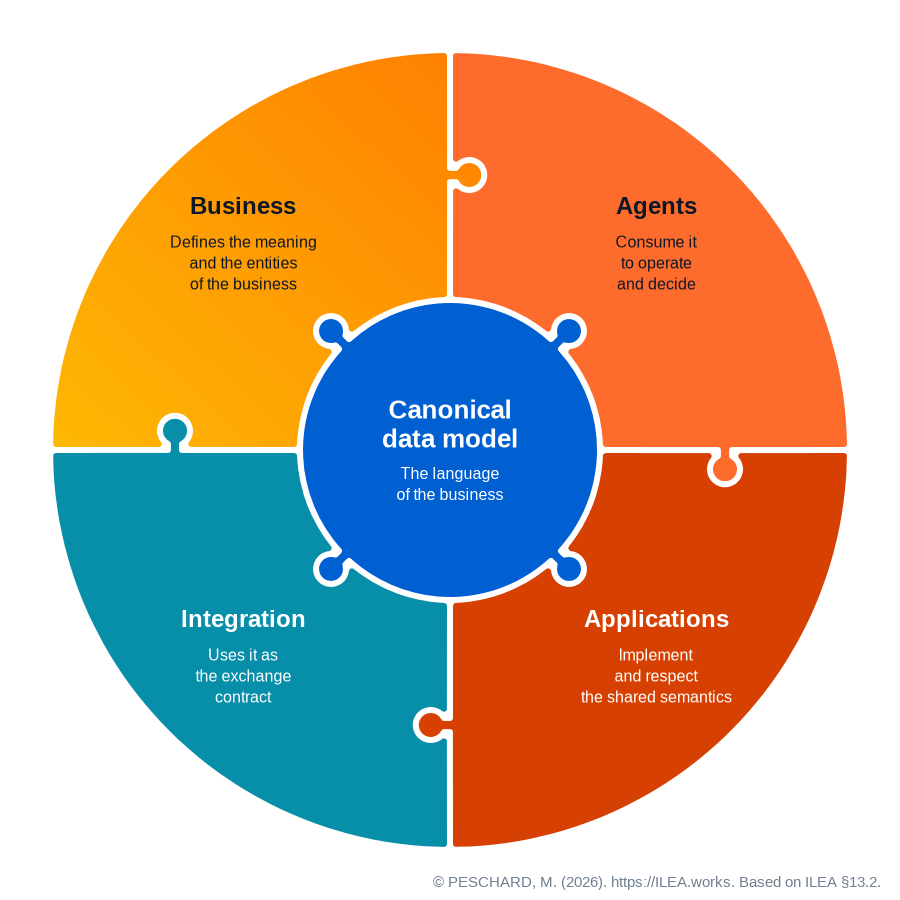
ILEA diagram, based on ILEA §13.2.[1]
It does not erase the differences between areas; it names them. When sales, credit, and logistics each define an “active customer,” the canonical model keeps each definition under its own name, with its own business owner, so that no report or agent mixes them up.[3][4]
It also simplifies integration. Hohpe and Woolf documented it as an integration pattern: six applications translating directly to each other need 30 translators; with a canonical model, they need 12.[2]
| Application model | Industry standard | Enterprise canonical model | |
|---|---|---|---|
| Purpose | Operate the system | Standardize an industry | Share the meaning of the business |
| Depends on | One application | The industry, not the vendor | No technology |
| Governance of meaning | Low | Medium | High: definitions and metadata |
| Ready for AI | No | Partially | Yes |
Author’s adaptation.[4]
The canonical model does not start from scratch. Industry standards, such as the Retail Data Model that the Object Management Group took over from the ARTS standards of the National Retail Federation,[5] and the packaged business-entity models of master data management platforms, such as Informatica’s Customer 360 and Product 360, documented field by field in data dictionaries,[6][7] are good starting points. In the author’s practice, the vendor models proved better documented than the industry standard. Either way, the canonical model adopts what serves and adds what makes the organization different.[4]
Next: Master data: one record for each thing
References
- Peschard, M. (2026). Intelligent & Lean Enterprise Architecture (ILEA), v1.21, §13.1–§13.2 (Data Domain). INDAUTOR Reg. 03-2026-020309540400-01. https://ilea.works/en/
- Hohpe, G., & Woolf, B. (2003). Enterprise Integration Patterns: Designing, Building, and Deploying Messaging Solutions. Addison-Wesley. Pattern “Canonical Data Model”: https://www.enterpriseintegrationpatterns.com/patterns/messaging/CanonicalDataModel.html
- Peschard, M. (2026). Chapter 2, “Transformación Digital Inteligente,” in GOCHY® Consulting Consortium, GALACRÁCKTICO® El Ejecutivo de 2040: Pensar Futuro. Decidir Hoy.
- Author’s adaptation, from the author’s practice designing and implementing data platforms.
- Object Management Group. (2017, June 26). Object Management Group Forms Retail Domain Task Force. https://www.omg.org/news/releases/pr2017/06-26-17.htm
- Informatica. Customer 360 SaaS Data Dictionary. Informatica Documentation. https://onlinehelp.informatica.com/IICS/prod/c360/en/bb-c360-introduction/Customer_360_SaaS_data_dictionary.html
- Informatica. Product 360 SaaS Data Dictionary. Informatica Documentation. https://onlinehelp.informatica.com/IICS/prod/p360/en/bb-p360-introduction/Product_360_SaaS_data_dictionary.html