
Business
Decisions climb a ladder. Analytics rises through five rungs, each resting on the one before: descriptive (what happened?), diagnostic (why?), predictive (what could happen?), prescriptive (what should we do?),[1] and automation with AI (how do we scale it?). Do not ask an AI agent to decide the future of a business that cannot yet explain its present.[2]
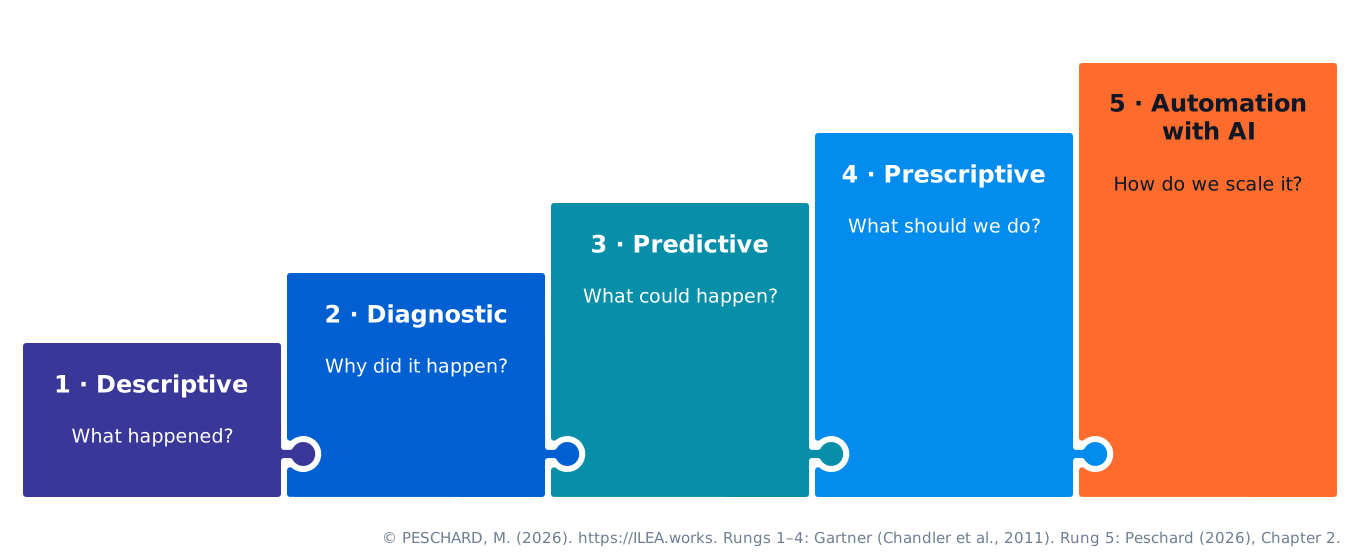
Rungs 1–4: Gartner (Chandler et al., 2011).[1] Rung 5: Peschard (2026), Chapter 2.[2]
The order matters. First simplify (Lean), then automate, then incorporate agents. Automating an inefficient process does not improve it; it makes it permanent.[2][3]
Autonomy is a business decision. The Business domain decides who decides and who executes in each process, and how much autonomy is acceptable for an agent. These decisions cannot be delegated to IT.[2] The Agents domain governs the levels of autonomy and human oversight.[4]
Business context makes AI reliable. What makes an agent trustworthy is not the model but the context the business gives it: definitions, formulas, business rules, limits, and the organization’s goals.[2]
Talking about AI is not getting value from it. In Q2 2026, 67% of S&P 500 earnings calls cited AI,[5] yet 95% of enterprise investments in generative AI produced no measurable impact on the income statement.[6] Value comes from redesigning how the business operates, not from adopting the technology.[2]
References
- Chandler, N., Hostmann, B., Rayner, N., & Herschel, G. (2011). Gartner’s Business Analytics Framework. Gartner. Cited in Siow, E., Tiropanis, T., & Hall, W. (2018). Analytics for the Internet of Things: A Survey. arXiv:1807.00971.
- Peschard, M. (2026). Chapter 2, “Transformación Digital Inteligente,” in GOCHY® Consulting Consortium, GALACRÁCKTICO® El Ejecutivo de 2040: Pensar Futuro. Decidir Hoy.
- Peschard, M. (2026). IDT, v1.3, §13–§15 (Lean Process Redesign, Intelligent Automation, and Governed Digital Agents).
- Peschard, M. (2026). ILEA, v1.21, §10.1–§10.2 (Agents Domain).
- FactSet. (2026, September 18). Earnings Insight. FactSet Research Systems. https://advantage.factset.com/hubfs/Website/Resources%20Section/Research%20Desk/Earnings%20Insight/EarningsInsight_091826.pdf
- MIT NANDA. (2025). The GenAI Divide: State of AI in Business 2025. Massachusetts Institute of Technology.