Purpose
Define which parts of the operating model should evolve and with what expected impact, with clear priorities and measurable results. It is not about transforming everything. Its components are the transformation intent, operational priorities, expected impact, and the Target Operating Model (TOM).
What It Defines
- which value streams are simplified, automated, or scaled;
- which operational capabilities require AI;
- which indicators will change to reflect the new way of operating.
Includes
Strategic objectives, critical capabilities, priority value streams, and impact criteria.
What Changes in Operations
- the focus moves from “digital projects” to evolving the operating model;
- technology investment is aligned with business priorities;
- the boundary of what will not be transformed is set.
Deliverables
- Statement of the operational evolution intent
- Map of prioritized value streams
- Transformation agenda aligned with impact
- KPIs redefined toward productivity, margin, or scalability
Indicators
- Cost per transaction
- Cycle time of key processes
- Margin by business line
- Productivity per operating unit
Risks If Missing
- Reactive digital initiatives
- Automation without structural impact
- Technology driving strategic decisions
- Operational saturation with little real improvement
Signs of Maturity
- Leadership can clearly describe the future operating model.
- Automation decisions respond to defined priorities.
- Impact is measured in performance, not in technology implementation.
Typical Quick Wins
[PENDING: quick wins for dimension 1; neither the context nor version 1.3 of the model includes them.]
Relationships
Sets the intent that guides Lean Redesign, Intelligent Automation, and Agents, on a coherent structural foundation.
In Practice
- How to answer “what to transform”: look at the company’s own value chain (suppliers and purchasing, supply chain, store operations and sales), supported by the support areas.
- Rule: the automations that move the needle are the ones that touch that chain. Before approving an initiative, it is worth asking which link it falls on and how much value it moves. If it falls on none, it can almost always wait.
- IT is no longer just another area: it sits beneath the entire chain. “Every company is now a software company,” in words attributed to Satya Nadella [1].
- Deciding out loud what will not be transformed is as strategic as defining the scope.
A transformation without direction is not a transformation. It is scattered spending with an approved budget.
— Mauricio Peschard
Target Operating Model (TOM)
Describes how the business will operate after the transformation.
It is not strategy. It is not technology. It is the future way of operating.
— Mauricio Peschard
It answers:
- Which processes will be automatic?
- Where will digital agents step in?
- Which decisions will AI augment?
- Which human roles change?
- Which operational metrics are optimized?
| Concept | What It Defines |
|---|---|
| Strategy | What the company wants to achieve |
| Traditional digital transformation | What technology to implement |
| Target Operating Model (TOM) | How future operations will work: this is IDT’s focus |
Why It Matters
It prevents the typical problem. The company says “we want AI,” the consultant replies “let’s implement ChatGPT,” and nobody knows how operations change. The TOM forces the company to define how the business will operate once it is digital and intelligent.
Retail Example
- Before: manual reports, slow replenishment decisions, a lot of administrative work.
- Strategy: “we want to grow profitably.”
- TOM: AI-based automatic replenishment, digital agents that produce executive reports, automated administrative processes, and real-time operational decisions.
“Now it is clear what to transform.”
The Five Elements of the TOM
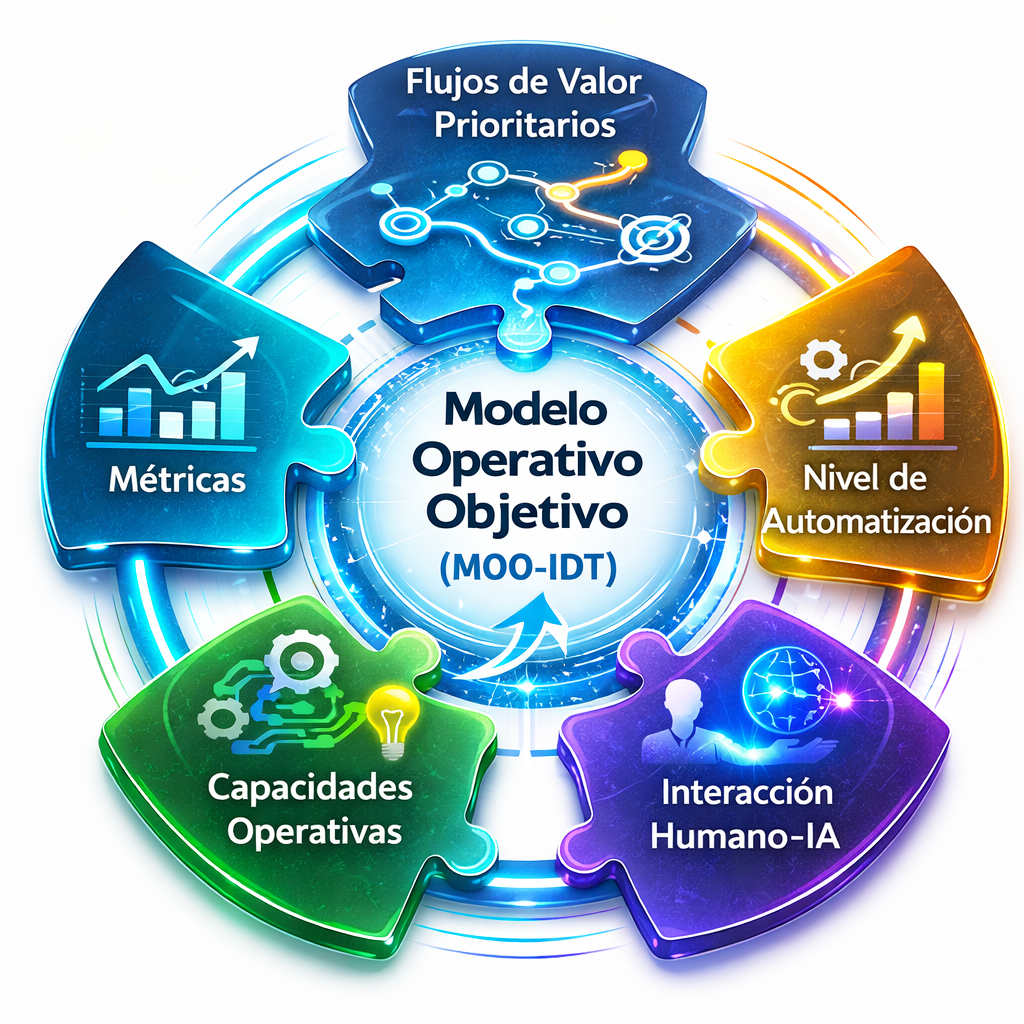
1. Priority value streams. Where real value is generated; which parts of the business are transformed first. Not every process is transformed: priority goes to those that affect revenue, operating cost, customer experience, or speed of operation. Examples: customer origination, order management, service operations, billing and collections.
2. Level of automation. Which part of the flow is automated and to what degree:
| Level | Operation |
|---|---|
| Manual | human execution |
| Assisted | digital tools |
| Automated | workflows or RPA |
| Intelligent | AI / agents |
3. Human-AI interaction. Who decides and who executes, so that accountability is clear. There are three schemes: Human-in-the-loop, Human-on-the-loop, and autonomous agents with safeguards, that is, Human-out-of-the-loop with governance (details in Governed Digital Agents).
4. Critical operational capabilities. Those the future model needs to guide initiatives. Examples: paperless digital operations, data-driven decisions, cross-cutting automation, commercial intelligence, execution agents.
5. Operating model metrics. How to tell that the model works better. Examples: cost per transaction, cycle time, productivity per employee, operating margin, level of automation.
References
- Nadella, S. (2019, February). Mobile World Congress, in a joint appearance with Dieter Zetsche (Daimler), according to Via Satellite (February 26, 2019). The phrase is the journalist’s summary, not a verbatim quote. The closest verbatim quote is in Microsoft’s official transcript of his Ignite 2015 keynote: “every business out there now is a software company, is a digital company.” https://news.microsoft.com/speeches/satya-nadella-ignite-2015