The Core Idea
A job has a purpose and a set of tasks. AI takes on the mechanical tasks and the purpose remains human.
| Purpose of the work (human-centric: human value is irreplaceable) | Tasks of the work (AI-centric: technology amplifies) |
|---|---|
| Expert judgment: interpreting complex situations, assessing risks and deciding, professional and ethical responsibility. | Automate repetitive tasks: capturing and structuring information, forms and workflows, integration between systems. |
| Relationships and trust: personalized service, sensitive or ambiguous situations, institutional trust. | Process information: extract data from documents, classify, validate fields and consistency. |
| Oversight and control: final validation of critical decisions, regulatory compliance, oversight of automated processes. | Reduce friction: eliminate data-entry errors, automatic traceability, standardization. |
| Strategic value creation: objectives and priorities, complex problems, new business opportunities. | Accelerate and scale: mass processing in seconds, 24/7 operation, scaling without growing headcount in the same proportion. |
| Human work is thinking, deciding, supervising, and creating value. | AI does not replace the purpose of human work: it reduces friction and amplifies capacity. |
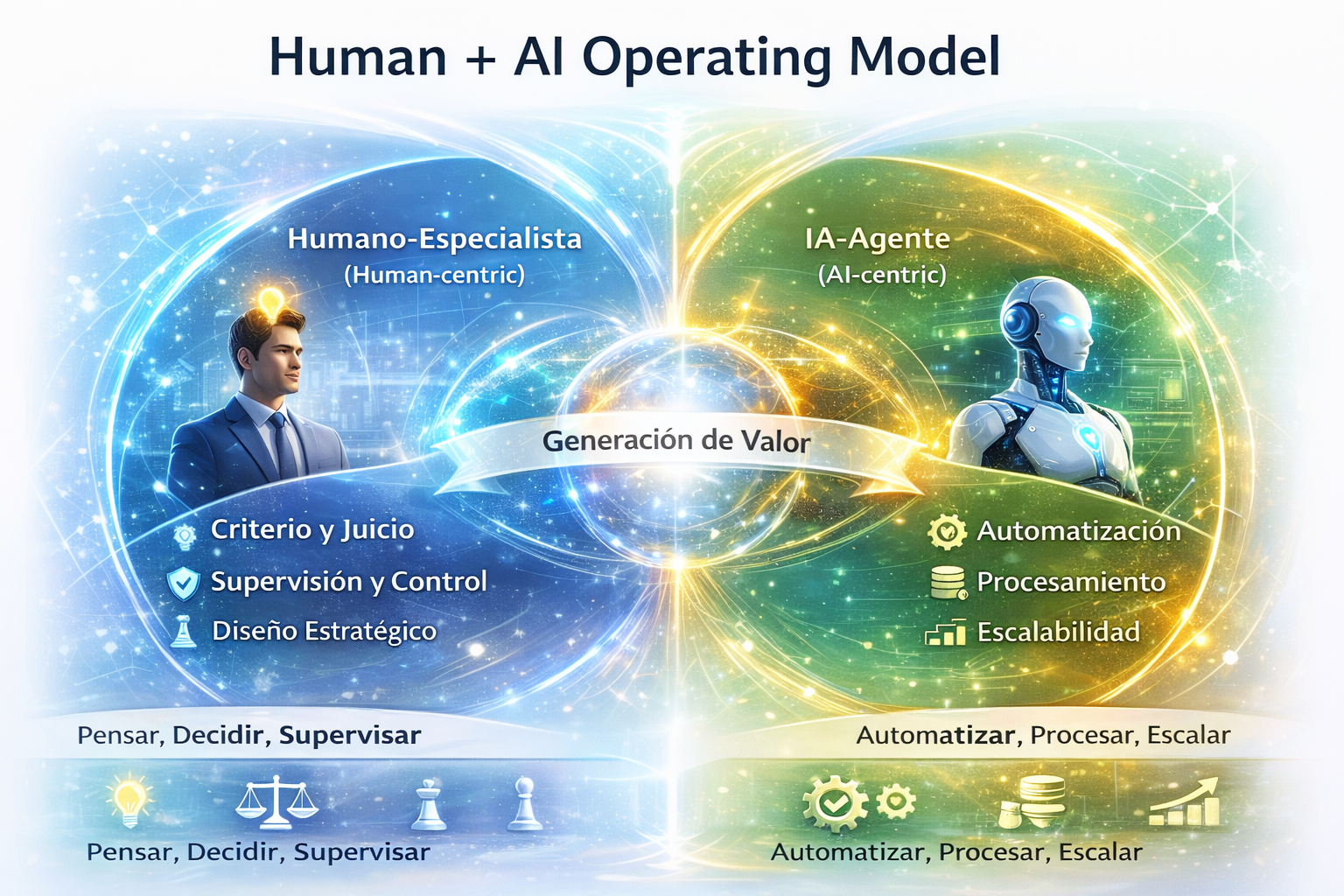
Human + AI Operating Model
On one side, the Human Specialist (judgment, oversight and control, strategic design): think, decide, supervise. On the other, the AI Agent (automation, processing, scalability): automate, process, scale. At the center, Value Creation.
What This Approach Is For
- it reinforces the Governed Digital Agents dimension;
- it connects with HITL/HOTL;
- it reduces the organization’s resistance to adopting AI.
In Practice
The relationship is an asset, not a cost to optimize. In Mexican wholesale, business is still built on personal trust and direct dealings. The salesperson who knows the store owner and knows when they can tolerate a delay is valuable.
Automating the relationship behind 15 years of purchases is not efficiency; it is destroying value with better productivity indicators.
— Mauricio Peschard
IDT’s criterion is not to automate as much as possible, but to place automation well. Human work keeps four territories: judgment in the face of ambiguity, relationships and trust, final validation, and value creation. Everything else is natural ground for automation.
The academic basis: David Autor (MIT) explains that a job is a bundle of tasks and that automation takes tasks, not whole jobs [1] [2].
AI does not replace the purpose of a job; it automates repetitive tasks to free up what is truly human.
— Mauricio Peschard
The question for the executive is not how many people AI replaces, but what their teams will use the hours it gives back for. If the answer is “more of the same,” the transformation did not happen: it just got cheaper.
The human cost of change: speed creates anxiety, and in a company anxiety looks like paralysis. The answer is not a motivational speech, but an honest diagnosis and a first step small enough to start on Monday.
References
- Autor, D. H. (2015). Why are there still so many jobs? The history and future of workplace automation. Journal of Economic Perspectives, 29(3), 3–30.
- Autor, D. H., Levy, F., & Murnane, R. J. (2003). The skill content of recent technological change: An empirical exploration. The Quarterly Journal of Economics, 118(4), 1279–1333.