Intelligent Digital Transformation (IDT)
Transforming is not buying technology or digitizing processes as they are: it is evolving the way the company operates.
What IDT Is
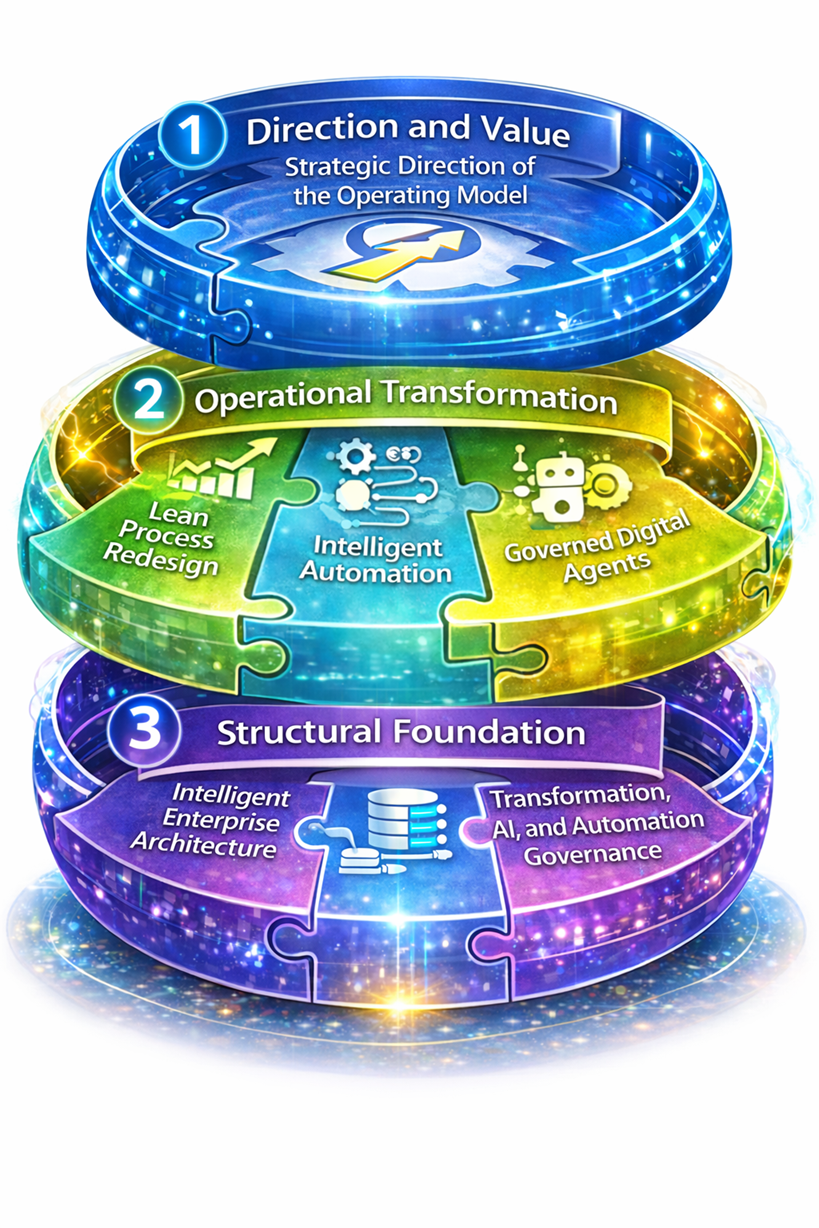
IDT is a digital transformation model that redefines it. Transforming is not buying technology or digitizing processes as they are: it is evolving the way the company operates (its operating model). IDT does not prescribe tools: it lets leadership assess where it stands, decide where it wants to go, and govern the path without fragmenting. It is organized into three layers and six dimensions. It was created by Mauricio Peschard, an enterprise architect with more than 30 years of experience, 20 of them at The Home Depot Mexico and the United States.
- It applies to any industry, regardless of its current level of digitization.
- It is independent of technologies, vendors, and tools.
- It does not replace existing methodologies or frameworks: it integrates them into a coherent view of the operating model.
What It’s For
- Evolve operations from manual, fragmented, or partially digitized schemes to digital, automated, and intelligent operations.
- Measure the gap and set the course: assess the current state, identify structural gaps, and define the desired (to-be) state.
- Design quick wins and long-term evolution together, avoiding technology fragmentation and isolated initiatives.
- Give leadership a common framework that aligns business decisions, process redesign, automation, and AI.
- Make transformation a leadership decision: stop treating it as a tactical or technology task and treat it as a strategic decision about the operating model, focused on value, scalability, and sustainability.
What “Intelligent” Means
It does not refer only to the use of advanced technology. It means integrating AI, digital agents, and automation in a structural and governed way, within a coherent architecture.
The Problem in Brief
The Data
- 95%. According to MIT NANDA (2025), 95% of enterprise investments in generative AI produced no measurable impact on the income statement, with an estimated spend of 30 to 40 billion dollars. That 95% is not projects that failed technically, since most of them worked: it is money that never came back. According to the study, AI success is 10% algorithms, 20% data and technology, and 70% people, processes, and culture [1].
- 70%. According to BCG (2020), up to 70% of digital transformations fall short of their objectives, and the deciding factor is almost never the technology but the organization [2].
- Mexico. According to INEGI’s 2024 Economic Census, only 8% of companies with 10 or more employees use AI, compared with an OECD average of 20.1% [3]. KPMG (2025) adds that most of those already investing have not defined what to transform or what impact to measure [4]. The gap is not one of access to technology, but of building.
The Uncomfortable Truth: AI Is Not Bought, It Is Built
What can be bought (licenses, models, platforms, compute), any competitor can buy the same week at the same price. What cannot be bought:
- processes redesigned so that they are worth automating;
- organized information that means the same thing across the whole company;
- a structure that makes it possible to reuse instead of rebuild;
- clear rules on what a machine decides and what a person decides;
- leadership capable of deciding where transformation matters and where it does not.
An intelligent layer on top of a fragmented foundation does not produce an intelligent company: it produces a fragmented company that now also has AI.
— Mauricio Peschard
References
- MIT NANDA. (2025). The GenAI Divide: State of AI in Business 2025. Massachusetts Institute of Technology.
- Boston Consulting Group. (2020). Increasing the Odds of Success in Digital Transformation. https://www.bcg.com/publications/2020/increasing-odds-of-success-in-digital-transformation · Report from the same research: Flipping the Odds of Digital Transformation Success (press release, October 29, 2020).
- Instituto Nacional de Estadística y Geografía (INEGI). (2024). Censo Económico 2024 (in Spanish). INEGI.
- KPMG. (2025). Panorama de la inteligencia artificial en México y Centroamérica 2025 (in Spanish). KPMG.